
GLAS Payment Tracker Excel Template Ireland
6
Free download
Track camogie fundraising events, organisers, targets, income, expenses, net profit and progress in a practical Irish club Excel template.
Download template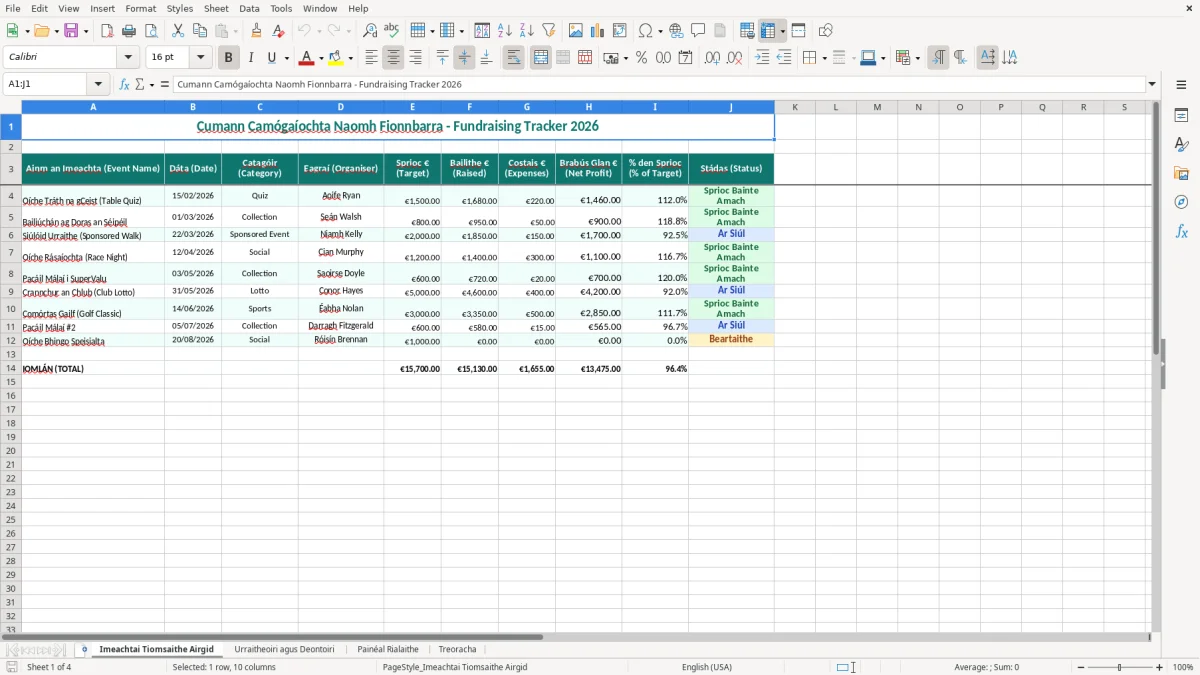
This camogie fundraising tracker Excel template records each event's name, date, category, organiser, target, amount raised, expenses, net profit, progress and status. It is designed for an Irish camogie club treasurer or fundraising committee managing quizzes, collections, sponsored events, race nights and club lotto activity during 2026.
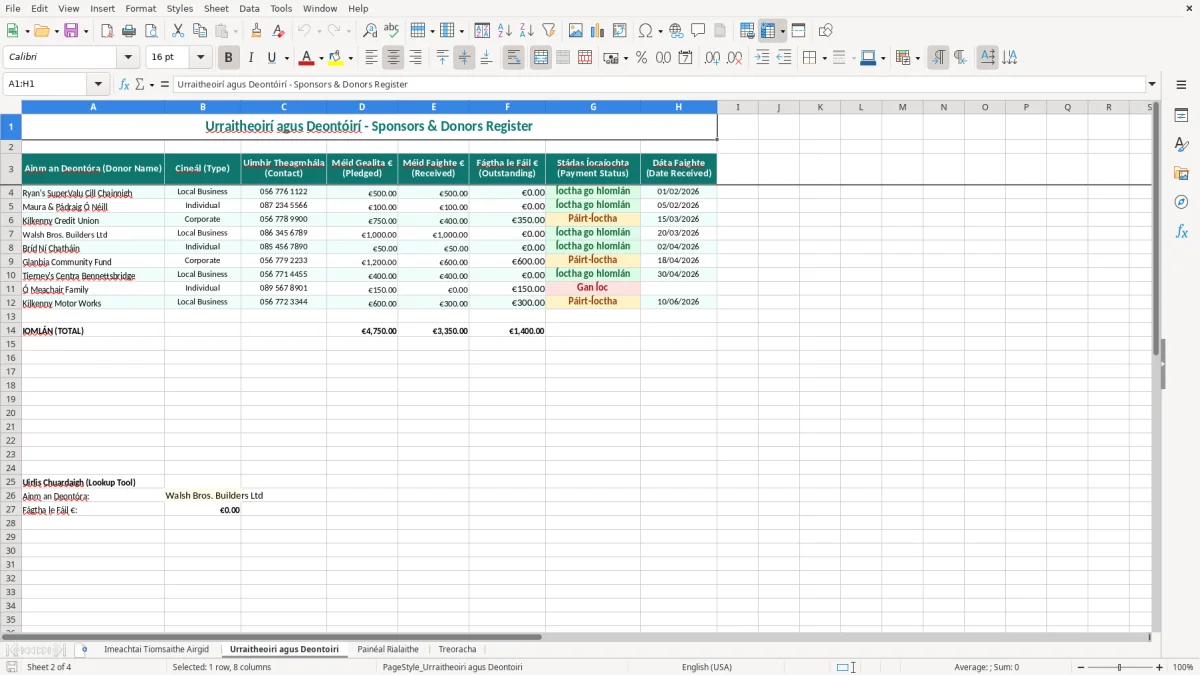
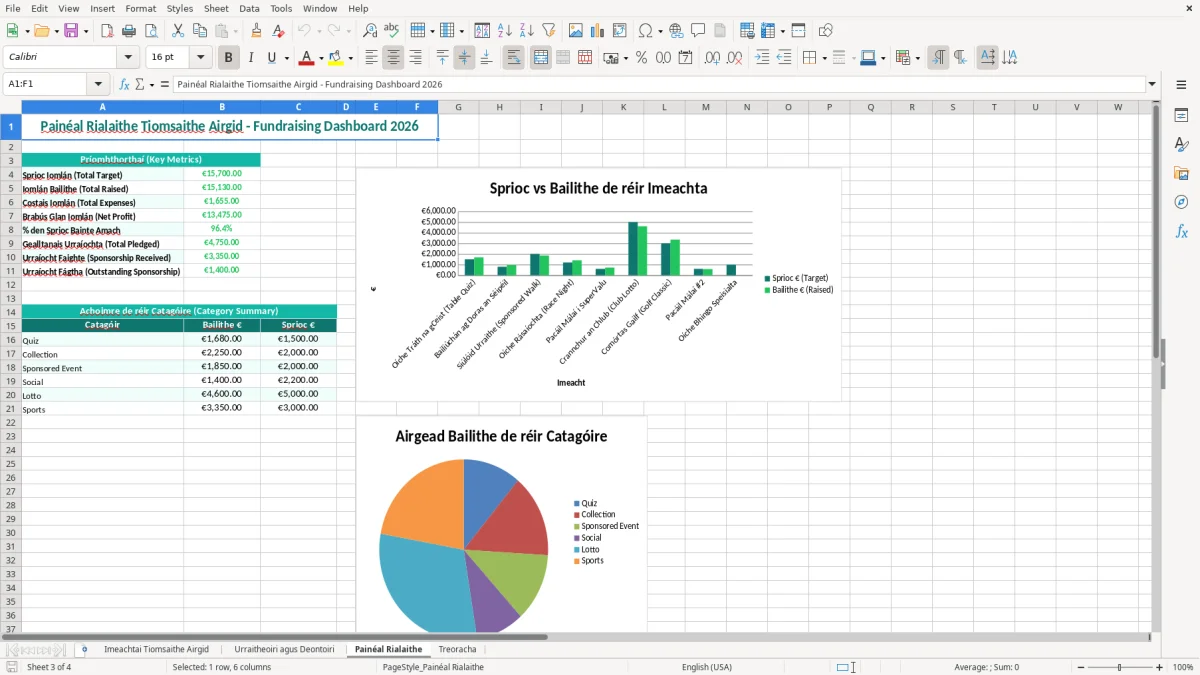
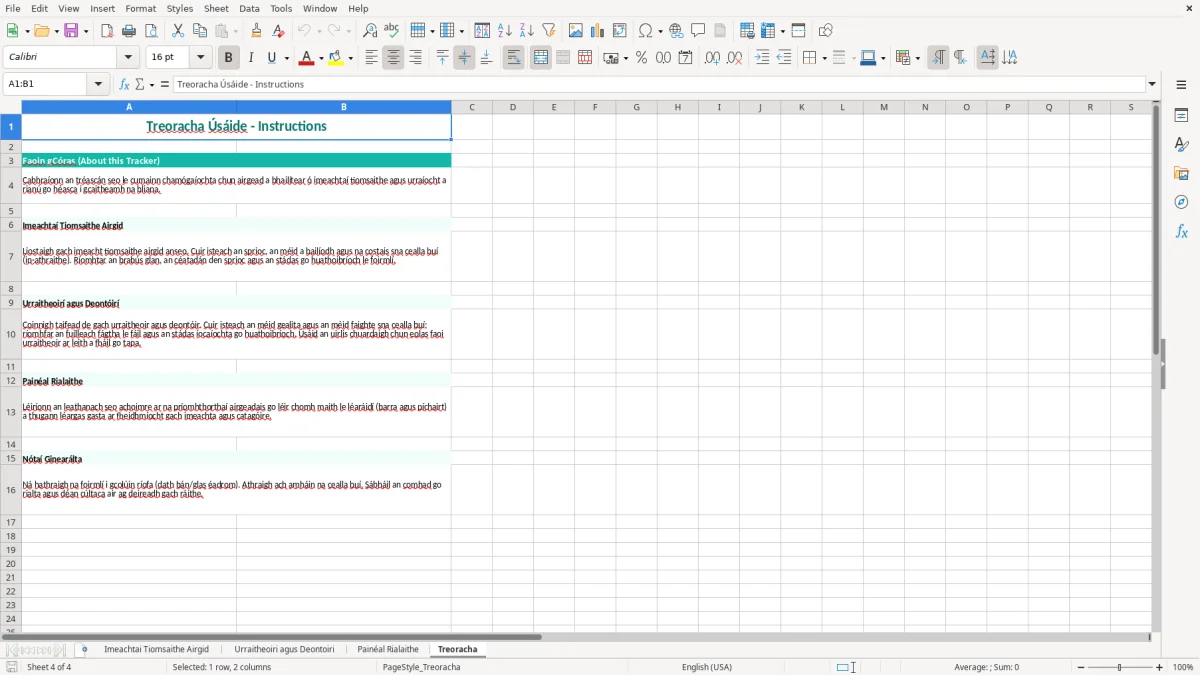
The workbook contains Imeachtai Tiomsaithe Airgid, Urraitheoiri agus Deontoiri, Painéal Rialaithe and Treoracha. Image 1 shows the event register with bilingual headings and coloured euro and percentage fields; image 2 shows the sponsor and donor sheet, while images 3 and 4 show the dashboard and instructions.
A camogie club committee will often agree its fundraising calendar before the first league match: a table quiz in February, a sponsored walk in March, a race night in April and a club lotto or collection later in the spring. The Imeachtai Tiomsaithe Airgid sheet gives the treasurer one row per activity, with the organiser named beside the financial target.
That matters when a club has several underage teams and adult panels raising money at the same time. A treasurer can ask Aoife to confirm the quiz takings, Seán to return collection records and Niamh to provide the sponsored-walk expenses without searching through three different message threads.
Suppose the quiz target is €1,500. The club collects €1,680 and pays €220 for venue hire, food and printing. The event's net profit is €1,460, and its progress against target is 112.0% before considering the expenses. That distinction is useful: the event exceeded its income target, but the committee should judge the final result on net profit.
Image 1 shows the practical layout: the first column holds the event name, followed by date, category and organiser; the later columns hold target, raised, expenses, net profit, percentage of target and status. The bilingual headings are particularly useful where a volunteer committee uses Irish and English terms interchangeably.
Urraitheoirí and Deontóirí are dealt with on their own sheet rather than being mixed into the event totals. This suits a club collecting sponsorship from local businesses, parents and former players, especially when a donor supports more than one activity during the 2026 season.
The Painéal Rialaithe is best used for the monthly committee meeting, not as a substitute for checking the bank statement. The treasurer should still match the summary to lodgement slips, online transfers and receipts before reporting a total.
This workbook is a fundraising control tool, not a replacement for the club's bank records or accounting file. Keep the event approval, cash count, online payment report, invoices and bank lodgement evidence with the relevant committee papers. A sensible minimum is one folder per event, named with the date in DD/MM/YYYY format.
For a quiz showing €1,680 raised and €220 expenses, the treasurer should be able to explain both figures: for example, €1,500 from ticket sales plus €180 at the raffle, matched to a €150 hall invoice and €70 for refreshments. The €1,460 net result should then agree to the club's records after timing differences are considered.
Do not assume every fundraising receipt is outside VAT. A genuine donation is different from payment for a meal, ticket, advertising package or merchandise, and the VAT treatment can differ again where the activity is run as a commercial trading operation. The standard VAT rate is 23%, with reduced rates of 13.5% and 9% and zero-rated or exempt supplies in specific cases.
VAT registration becomes compulsory when taxable turnover passes €37,500 for services or €75,000 for goods. A club that is VAT-registered may have bi-monthly VAT3 returns and an annual Return of Trading Details through ROS, so event receipts and invoices need to be classified rather than simply totalled.
If the second sheet contains names, phone numbers, email addresses or donation details, the club is handling personal data under the GDPR and the Data Protection Act 2018. The committee should document why it holds the information, restrict access to the treasurer and authorised officers, and set a retention period instead of keeping donor lists indefinitely.
Revenue records generally need to be retained for 6 years where they support a tax or VAT obligation. Keep the spreadsheet's financial evidence with the club's underlying records, and use a read-only or password-protected copy when circulating reports outside the committee.
The most common problem I see with volunteer committees is announcing the amount collected as the amount raised for the club. A race night may bring in €1,400 but cost €300 for prizes, venue and promotion, leaving €1,100 before any other allocation. Reporting €1,400 as the contribution overstates what the club can spend on equipment or pitch costs by €300.
The event sheet's separate Bailithe € and Costais € columns force that conversation to happen. If an event shows €950 collected and €50 spent, the net result is €900; if the expense is entered as €5.00 by mistake, the apparent profit rises by €45 and the dashboard becomes misleading.
A collection may include €620 in cash, €280 through an online payment link and €50 in a sponsor envelope. Entering €950 without keeping the three supporting totals makes a later bank reconciliation difficult. It also leaves the committee unable to identify a shortfall if only €930 reaches the bank.
Use two people for a cash count and retain a signed count sheet. For a club with four fundraising events in a month, spending 15 minutes per event on a count and lodgement check is far cheaper than trying to reconstruct €3,000 of mixed receipts at year end.
A target is sometimes changed after the event has started because the original number was unrealistic. That hides the difference between an event that reached 100% of its agreed target and one whose target was quietly reduced from €2,000 to €1,500.
Record the committee-approved target and explain any change in the meeting minutes. Also check dates carefully: a sponsored walk entered as 22/03/2026 can be included in the wrong monthly report if someone types 22/03/2026 as text in one row and uses a real Excel date in another.
Record any related trading details return alongside the approved target so the monthly figures and the committee minutes stay tied to the same set of dates and receipts.
The tracker will last beyond the first fundraiser if updating it is a named responsibility. Put a 10-minute fundraising check on the agenda for the first committee meeting each month: the organiser confirms income and expenses, the treasurer checks the evidence, and the secretary records any action.
For example, on the first Monday in April, the treasurer can update the €1,850 collected from the sponsored walk, add the €150 expenses and confirm the €1,700 result before the meeting starts. That is more reliable than waiting until the end of the playing season and trying to remember six events.
Keep the original sample workbook untouched and save working copies with a clear date, such as Camogie_Fundraising_2026_04-06.xlsx. Use the Treoracha sheet as the reference before deleting rows or changing the bilingual headings.
For a small club with 10 to 20 fundraising events a year, this workbook is usually easier than introducing a full accounting system. Move to a shared finance system when several people need simultaneous access, the sponsor list exceeds roughly 300 records, or the club needs formal approval workflows, user permissions and automatic bank feeds.
Keep one controlled master file rather than allowing five committee members to edit separate copies. The simplest control is a named treasurer who updates the file, exports a dashboard summary for the meeting and stores the approved version with the minutes.
That same controlled handoff works for grant income tracking, where one approved file keeps the figures aligned with the minutes and avoids version drift.

 Excel template built and verified by Ciara Byrne, Chartered Accountant (ACA) · builds the Excel templates.