
GLAS Payment Tracker Excel Template Ireland
6
Free download
Irish Men's Shed accounts workbook with a Cuntais ledger, Achoimre summary and Treoracha sheet for tracking income, spending and balances.
Download template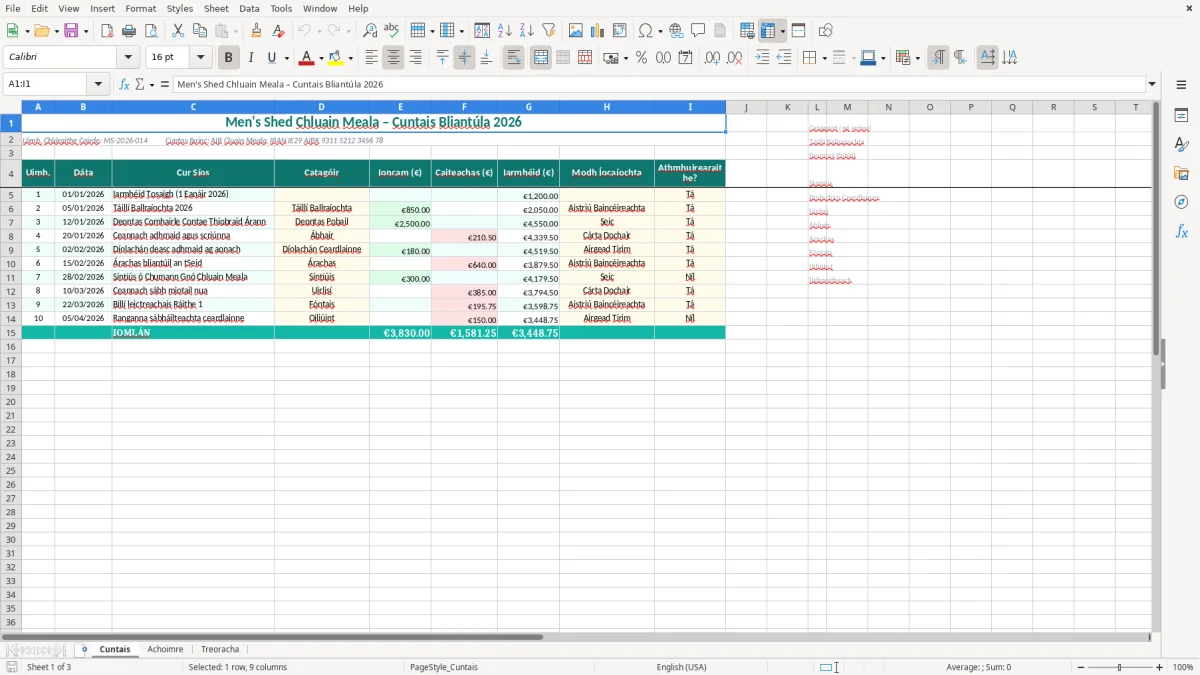
This Men's Shed accounts Excel template is a simple record-keeping workbook for logging subscriptions, grants, fundraising income and day-to-day spending. It contains a Cuntais ledger, an Achoimre summary sheet and Treoracha instructions, with euro amounts, dates, payment methods and running balances.
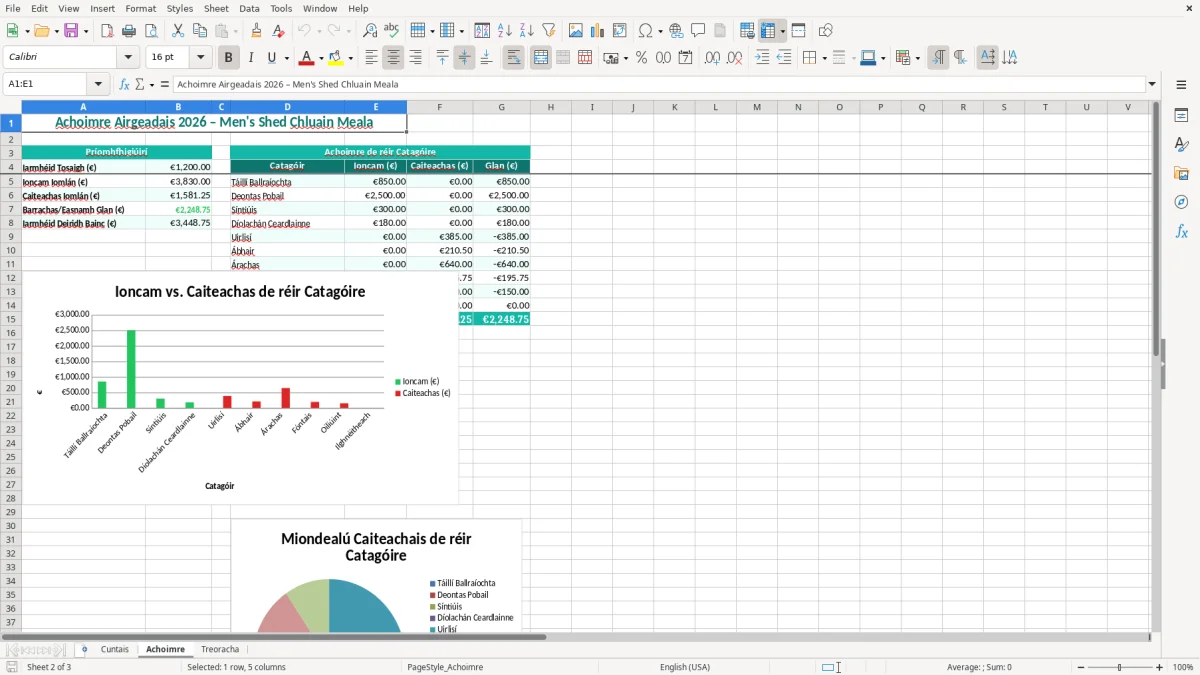
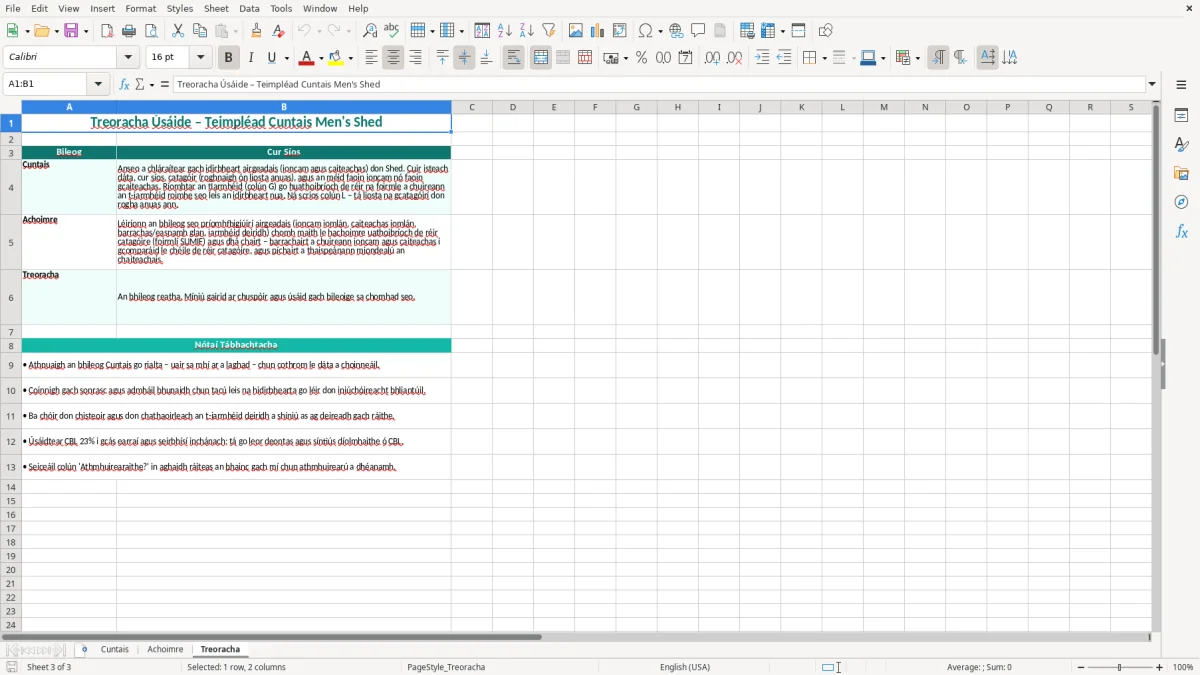
It suits a volunteer treasurer who needs a clear record for committee meetings, grant reports and the annual handover. Image 1 shows the Cuntais sheet with its teal headings and columns for income, expenditure, balance, payment method and recharge status; image 2 shows the summary layout, while image 3 contains the instructions.
A Men's Shed treasurer usually opens this workbook after the monthly bank statement arrives, not just at year end. The same file can support a committee meeting, a county council grant return, a membership renewal drive or the handover between two volunteers. Image 1 shows the Cuntais sheet as a transaction ledger rather than a blank household budget: it has Uimh., Dáta, Cur Síos, Catagóir, Ioncam (€), Caiteachas (€), Iarmhéid (€), Modh Íocaíochta and Athmhuirearaithe?.
Suppose 34 members each pay €25 for the year. The treasurer records €850 as Táillí Ballraíochta, just as the sample row does. A €2,500 community grant is recorded separately as Deontas Pobail, while €210.50 for timber and screws goes in Caiteachas (€) under Ábhair. Those categories tell the committee what funds came in and what the workshop actually consumed.
A shed might also record tea and coffee, insurance, electricity, tool repairs, training and sales of items made in the workshop. Keep one transaction per row; do not combine six weeks of receipts into a single vague entry. That gives the chairperson a usable explanation when a balance changes by €480 rather than merely showing that the bank balance is lower.
For a small shed, a Friday afternoon once a month is usually enough to enter the bank activity while the statement is open. Before the annual general meeting, the treasurer can use the Achoimre sheet shown in image 2 to discuss the position, and image 3's Treoracha sheet gives the incoming volunteer a starting point.
The practical stance is to update this after every bank statement, rather than waiting until December. If 20 transactions take 25 minutes to enter monthly, that is roughly five hours across a year; rebuilding 240 transactions before the AGM can take a full weekend and creates far more scope for omissions.
That same monthly rhythm also keeps fundraising entries aligned, and the club fundraising tracker can carry those receipts alongside the bank activity before the AGM.
This workbook is a management record, not a substitute for the Men's Shed's constitution, grant agreement or statutory accounts where those apply. Keep the original bank statements, invoices, receipts, grant letters, membership records and committee approvals with the workbook. Revenue generally expects business and tax records to be kept for 6 years; a community group should adopt the same six-year retention period as a sensible minimum for financial supporting documents.
A grant is not automatically ordinary unrestricted income. Read the funder's conditions and record the grant description accurately, such as Deontas Pobail, then retain evidence of the permitted spend. If a €2,500 grant is restricted to workshop equipment and €600 is spent on insurance, the spreadsheet may still show a cash outflow but the committee has a €600 compliance problem with the funder.
Do not treat a bank balance as the same thing as available grant money. A shed with €4,000 in the bank may have €2,500 ring-fenced, leaving only €1,500 for general running costs. The Achoimre sheet should be read alongside the grant schedule and minutes approving significant purchases.
Many volunteer-run sheds are not VAT-registered businesses, but that status should not be assumed from the word community. If the organisation makes taxable supplies as an economic activity, the Irish VAT registration thresholds are €37,500 for services and €75,000 for goods; the standard VAT rate is 23%, with reduced rates of 13.5% and 9% applying to specified supplies. A VAT-registered organisation should retain invoices showing the supplier details, invoice number, date, VAT number and VAT separately by rate.
Where the group is a registered charity, the Charities Regulator's reporting requirements and the charity's governing document matter. Where it is an unincorporated association, trustees or committee members may have different responsibilities from a company registered with the CRO. My firm preference is to record the cash ledger here and keep a separate folder for approvals and funder restrictions, rather than pretending a single balance column is a full set of accounts.
The most common failure I see in volunteer accounts is not a difficult accounting entry. It is a missing link between the spreadsheet and the bank statement: a receipt is entered twice, a cash collection is forgotten, or a card payment appears with no invoice. The error can sit unnoticed until the treasurer changes, at which point nobody knows whether the €300 difference is a real purchase or a data-entry mistake.
Imagine 12 members pay €25 in cash at the workshop. That is €300 of income. If only 10 payments are entered, the ledger is €50 short; if the full €300 is entered but only €250 reaches the bank because one member is still to pay, the reconciliation also fails. Label cash collections clearly and agree who counts, records and lodges them.
Another frequent mistake is putting a €210.50 timber purchase in both Ioncam (€) and Caiteachas (€), often because the volunteer copies a row and forgets to clear the receipt column. The apparent balance then rises by €210.50. The fix is firm: every row is either income, expenditure or a non-cash opening/reference item, never both.
A volunteer may pay €84.60 for screws and claim it back three months later. If the original debit card purchase is recorded as expenditure and the reimbursement is then entered as income without a description linking the two, the Achoimre can make ordinary activity look like fundraising. Mark the reimbursement in Athmhuirearaithe? and keep the receipt and approval together.
Lost paperwork has a real cost. A €1,200 tool purchase without an invoice may be rejected in a grant audit, leaving the shed to fund it from unrestricted money. A €2,500 grant with €500 of unsupported expenditure can create an avoidable request for clarification or repayment. In practice, a five-minute receipt check at each monthly entry is cheaper than searching through members' phones before an annual report.
That same five-minute check also keeps weekly collection records aligned with the receipts before the annual report is compiled.
The workbook works best when it is attached to an existing event: opening the monthly bank statement. Set a fixed date, such as the first Tuesday after the statement arrives, and complete the entries before the committee meeting. For a shed with 25 transactions a month, a 30-minute routine is more reliable than a once-a-year session with 300 uncategorised lines.
Use the teal headings as the fixed structure and avoid inserting columns into the middle of the ledger unless you understand how the summary references work. The input cells are visually distinct with a pale yellow fill in the workbook style, while the Cuntais headings use teal and white text. That makes it easier to tell a typed value from a calculated or labelled area during a busy committee evening.
This template is a good fit for one bank account and a modest number of annual transactions. Move to accounting software when the shed has several restricted grants, a payroll, regular VAT returns, stock sales or more than about 1,000 transactions a year. At that point, bank feeds, audit trails and user permissions are worth more than the flexibility of a hand-maintained workbook.
Keep a read-only year-end copy and do not overwrite the prior year's file. If a new treasurer takes over, spend 20 minutes together on image 3's Treoracha sheet, then perform the first bank reconciliation jointly; that handover is the strongest control the spreadsheet can have.

 Excel template built and verified by Ciara Byrne, Chartered Accountant (ACA) · builds the Excel templates.