
GLAS Payment Tracker Excel Template Ireland
6
Free download
Record weekly church collections by income type, counters, lodgements and target, with a dashboard for parish treasurers in Ireland.
Download template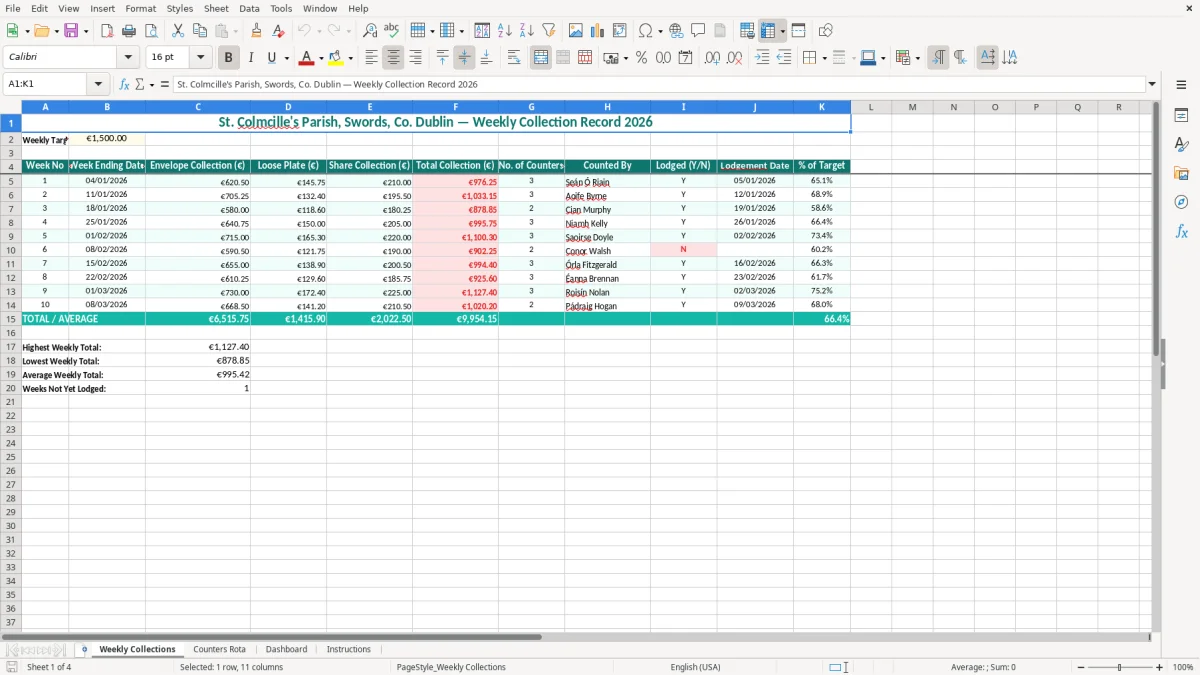
This parish church weekly collection Excel spreadsheet records envelope, loose plate and share collections by week. It also captures the number of counters, who counted the money, whether it was lodged, the lodgement date and progress against a weekly euro target.
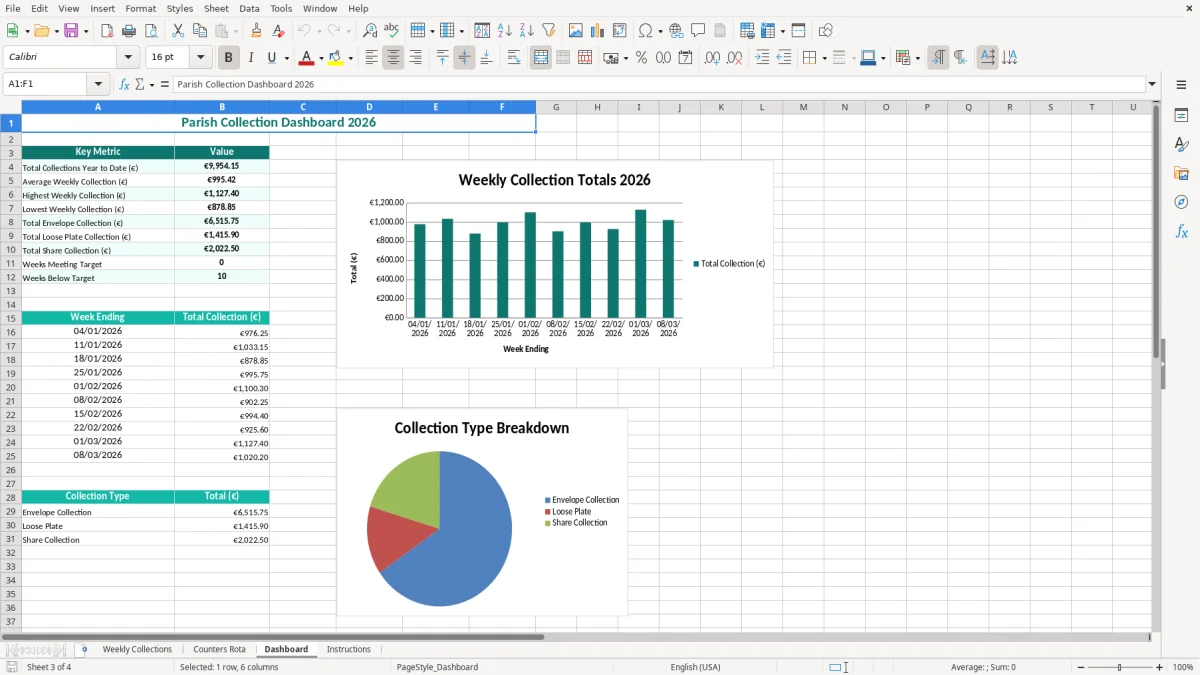
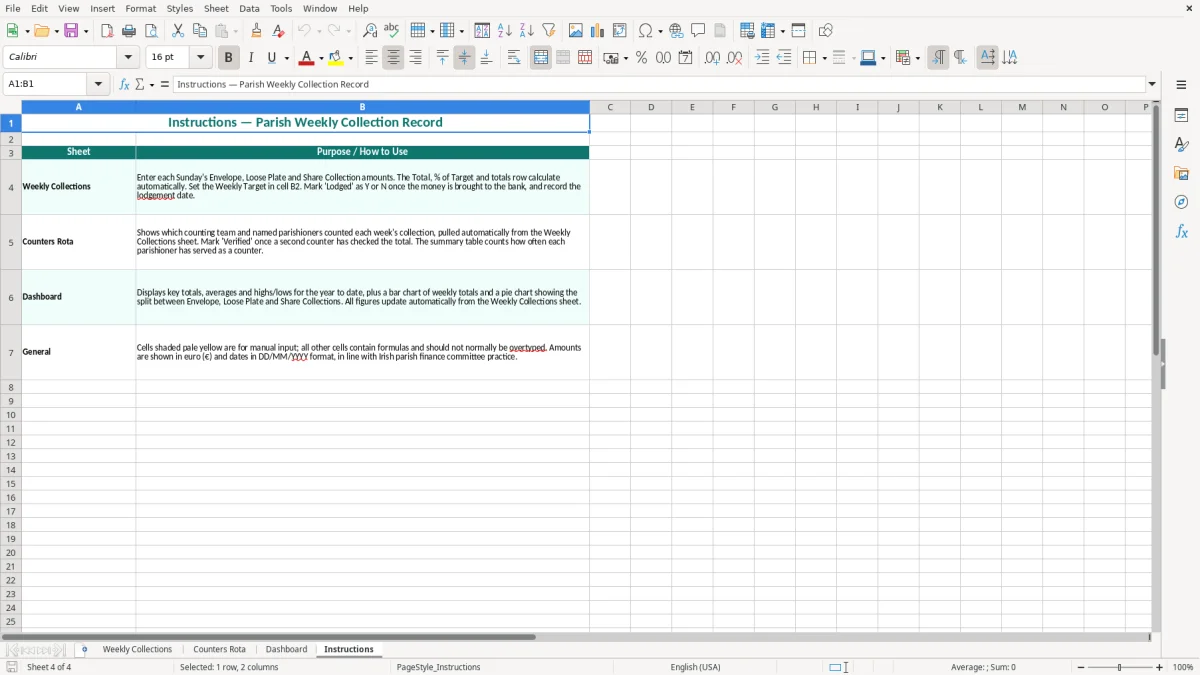
The workbook contains four sheets: Weekly Collections, Counters Rota, Dashboard and Instructions. The first sheet is the working record, while the rota supports counter planning and the dashboard gives the treasurer a quick view of collection performance.
A parish treasurer usually opens this record after the Sunday count, not at year end when everyone is trying to reconstruct twelve months of envelopes and bank lodgements. It suits a parish council, sacristan, finance committee or volunteer bookkeeper who needs a simple weekly control without introducing a full accounting package.
Image 1 shows the Weekly Collections sheet. The visible columns run from Week No and Week Ending Date through Envelope Collection (€), Loose Plate (€), Share Collection (€), Total Collection (€), No. of Counters, Counted By, Lodged (Y/N), Lodgement Date and % of Target. The weekly target is displayed at the top, with the example set at €1,500.
In practice, two or three volunteers count the money after Mass, complete the physical count and pass the cash for lodgement. For the week ending 04/01/2026, the example has €620.50 in envelopes, €145.75 on the loose plate and €210.00 in the share collection: €976.25 altogether, or 65.08% of a €1,500 target.
The next working day, the treasurer can enter the lodgement date, such as 05/01/2026, and mark the row Y. That creates a useful link between the collection sheet, the bank statement and the deposit slip, rather than leaving the fact of banking in somebody's memory.
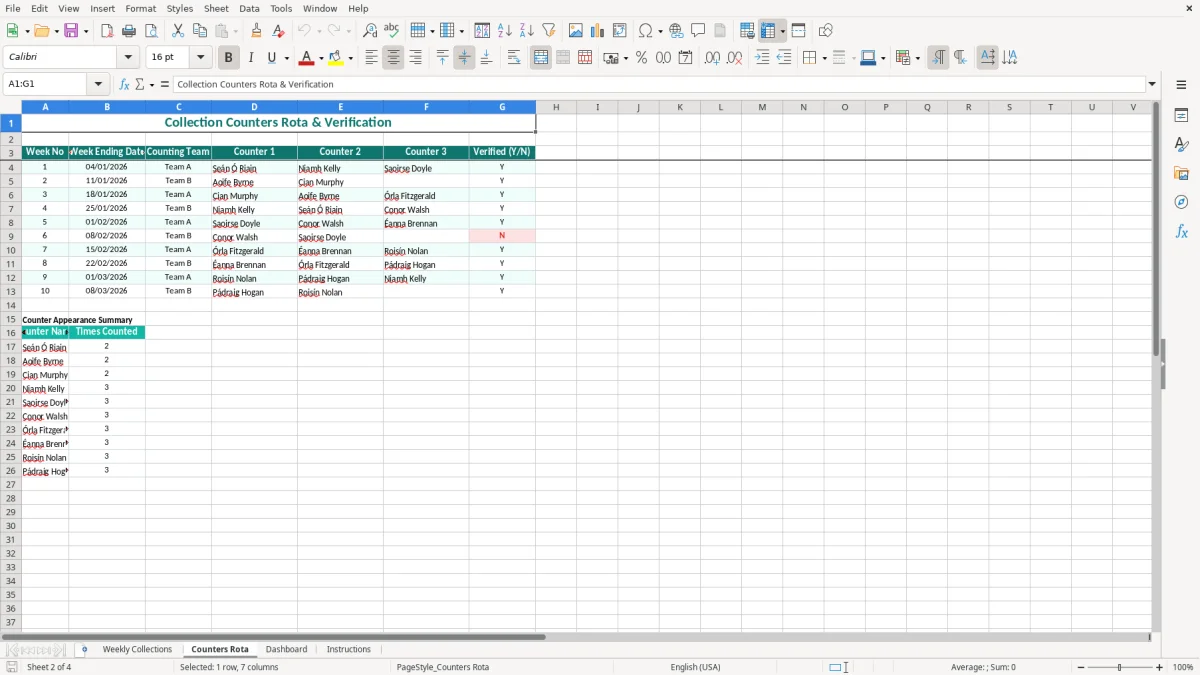
A bookkeeper in a parish with several Masses can use the same weekly row after the counters combine the sealed bags. A smaller rural church may have one treasurer and a rotating pair of volunteers. The Counters Rota sheet is particularly useful before Christmas, Easter, holidays and the start of a new parish year, when the usual volunteers may not be available.
Image 2 shows the Counters Rota sheet, image 3 shows the Dashboard and image 4 shows Instructions. The treasurer should use the dashboard for a quick committee review, but keep the detailed weekly row and the bank evidence as the underlying record.
A weekly collection is normally a donation rather than a payment for a taxable supply, so a parish does not add 23% VAT to ordinary offertory money. That does not make every church receipt a donation: a trading activity such as a bookshop, café, room hire or paid event needs to be assessed separately, and its records should not be mixed casually with Sunday collections.
For a church recognised as a charity, the Charities Act 2009 and the Charities Regulator's governance expectations make clear records and proper financial controls important. A parish should also establish whether it has a registered charity number, a diocesan reporting arrangement or another governing structure. Revenue charitable tax exemption is not simply created by labelling an account charitable.
Keep the spreadsheet, count sheets, bank lodgement slips, bank statements, invoices and committee approvals together. Revenue's general record-keeping period is 6 years, and that is a sensible minimum for financial records even where the parish's annual accounts are prepared for a diocese or charity body.
The workbook is a control record, not proof by itself. If the row for 11/01/2026 shows €1,033.15 and a lodgement on 12/01/2026, the bank statement should show a matching deposit or an explained difference. The €1,033.15 figure comes from €705.25 envelopes, €132.40 loose plate and €195.50 share income.
Use two counters where possible, have both sign the physical count sheet and restrict the electronic file to authorised parish officers. Names in Counted By and the rota are personal data under GDPR and the Data Protection Act 2018, so do not email the full workbook to a broad volunteer mailing list or leave printed lists in the sacristy.
The parish should decide whether the spreadsheet is maintained for the parish itself, a diocesan body or a registered charity. That decision affects who approves payments, who reviews the bank reconciliation and who receives the annual financial report. My practical preference is to keep collection totals in this workbook, then post the verified totals into the main accounts once a month.
That monthly posting is easier to sign off when the figures are carried into a treasurer report format alongside the bank reconciliation and annual financial report.
The first failure I see is a total with no breakdown. If a treasurer enters €1,000 for a Sunday but cannot say whether it was €700 in envelopes, €180 on the plate and €120 for the share collection, a missing bag or an incorrect transfer can remain hidden. The three income columns are useful precisely because they make the count challengeable.
A count of €976.25 followed by a bank lodgement of €966.25 is a €10.00 difference, not a rounding issue. It may be a note left in the counting room, a bank charge or a transcription error. Without the count sheet and deposit slip, the treasurer may spend an hour searching for a discrepancy that should have been investigated on Monday.
Another common error is entering the bank date but leaving Lodged (Y/N) blank, or marking Y before the cash has actually reached the account. That makes the spreadsheet look complete while the bank reconciliation still has an unexplained €1,033.15 deposit missing. The rule I use in workshops is simple: Y means seen on the bank evidence, not merely placed in an envelope.
Rotas also fail when the same person is assigned every week or when a substitute is not written down. If the scheduled counter is on holidays and the actual counter is absent from Counted By, the record cannot show who handled the cash. A four-week gap around July can leave twelve or more collections depending on the number of Sunday services.
Finally, parish files are often overwritten. A volunteer may save a new copy as Collection final.xlsx and lose the previous month. Keep one controlled workbook, use a dated backup such as Parish Collections 2026-01-31.xlsx, and do not store it on a personal USB key. A €1.00 unexplained difference is easier to resolve than a missing quarter of records.
A €1.00 unexplained difference is easier to resolve than a missing quarter of records, and the same controlled workbook approach carries over to VAT3 return workings when the figures need a clear audit trail.
The spreadsheet works best when it is attached to an existing handover rather than treated as an occasional accounts job. Set a fixed Monday routine: collect the count sheet, compare the bank deposit, update the relevant row and save a dated backup. This normally takes less than 15 minutes for a small parish once the habit is established.
Keep the file on a restricted parish or diocesan drive, with a monthly read-only PDF export if the finance committee needs a permanent meeting pack. Use a consistent filename and retain the original workbook so the formulas and input cells remain available for the next week.
For a parish taking €1,500 a week, annual collections could approach €78,000 over 52 weeks. At that scale, a spreadsheet remains practical if there are few bank accounts and one finance team, but a parish with several churches, card terminals, standing orders, payroll and grant income should move to bookkeeping software or a diocesan system.
Do not add extra complexity merely because the parish has a dashboard. A controlled weekly count, prompt bank reconciliation and monthly review are more valuable than a workbook with 20 unused tabs. Keep this file for collection control, and use the main accounts for the full profit and loss, balance sheet and restricted-fund reporting.

 Excel template built and verified by Ciara Byrne, Chartered Accountant (ACA) · builds the Excel templates.