
GLAS Payment Tracker Excel Template Ireland
6
Free download
Annual Tidy Towns budget spreadsheet with budget lines, funding, income, actual costs, variance and dashboard reporting for Irish committees.
Download template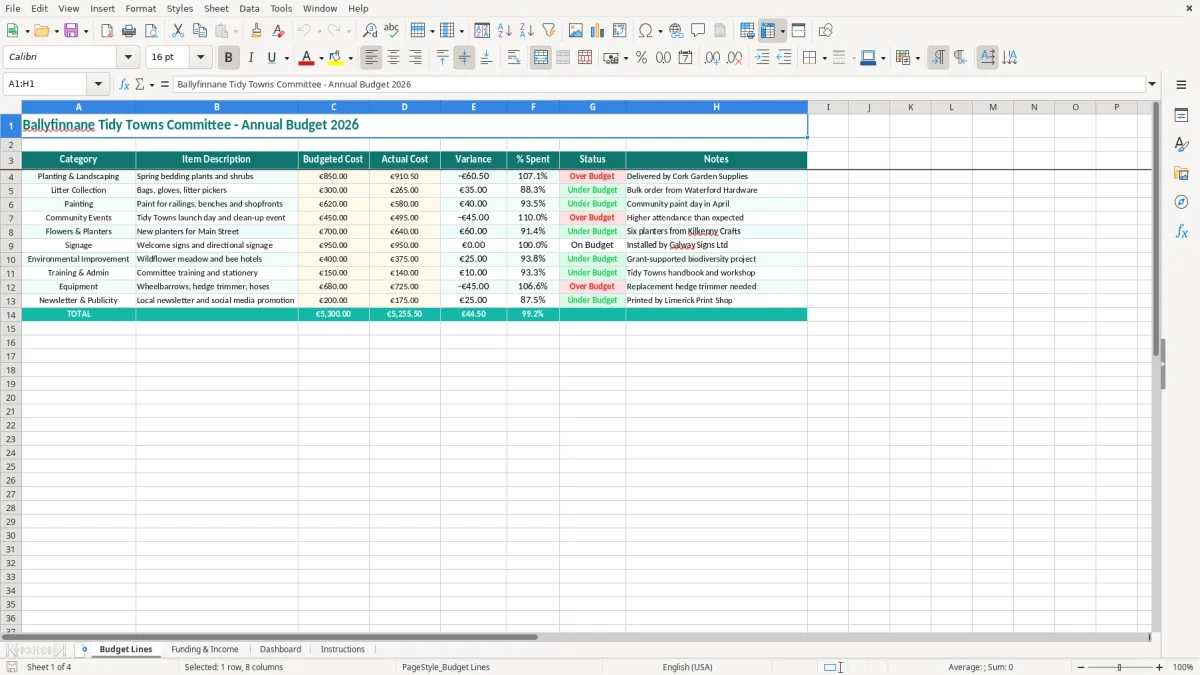
This Tidy Towns budget Excel spreadsheet records planned and actual spending for an Irish committee. It includes budget lines, funding and income, variance tracking, status updates and a dashboard so your treasurer can see how much of the annual budget has been used.
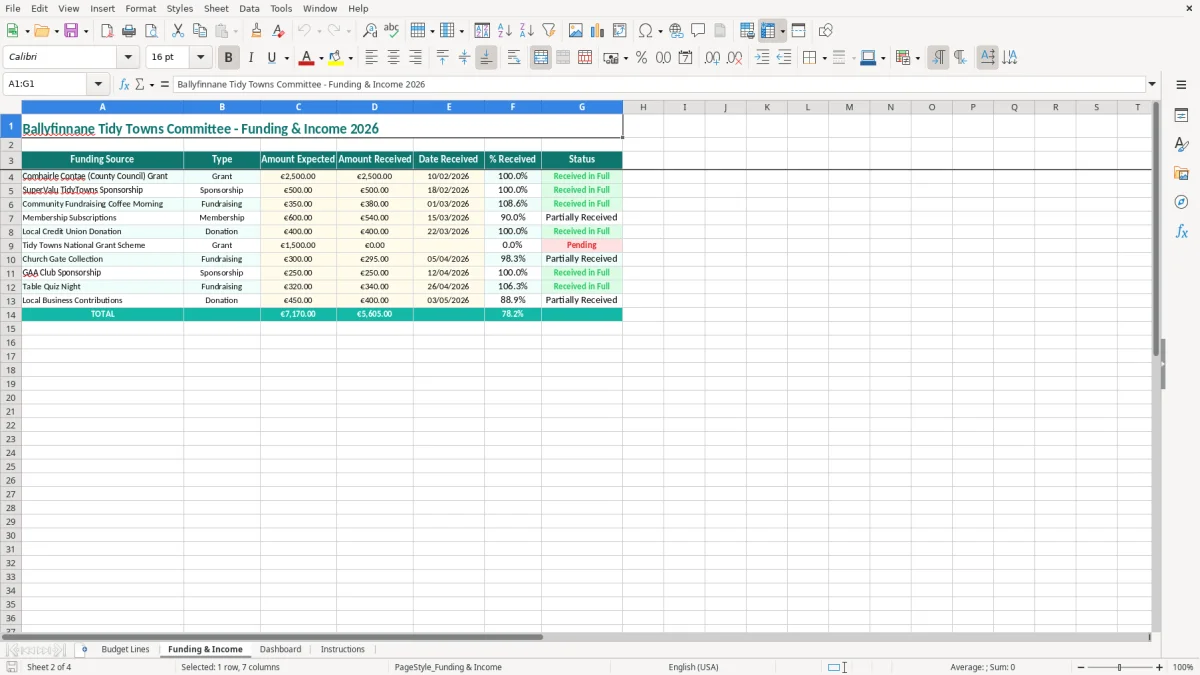
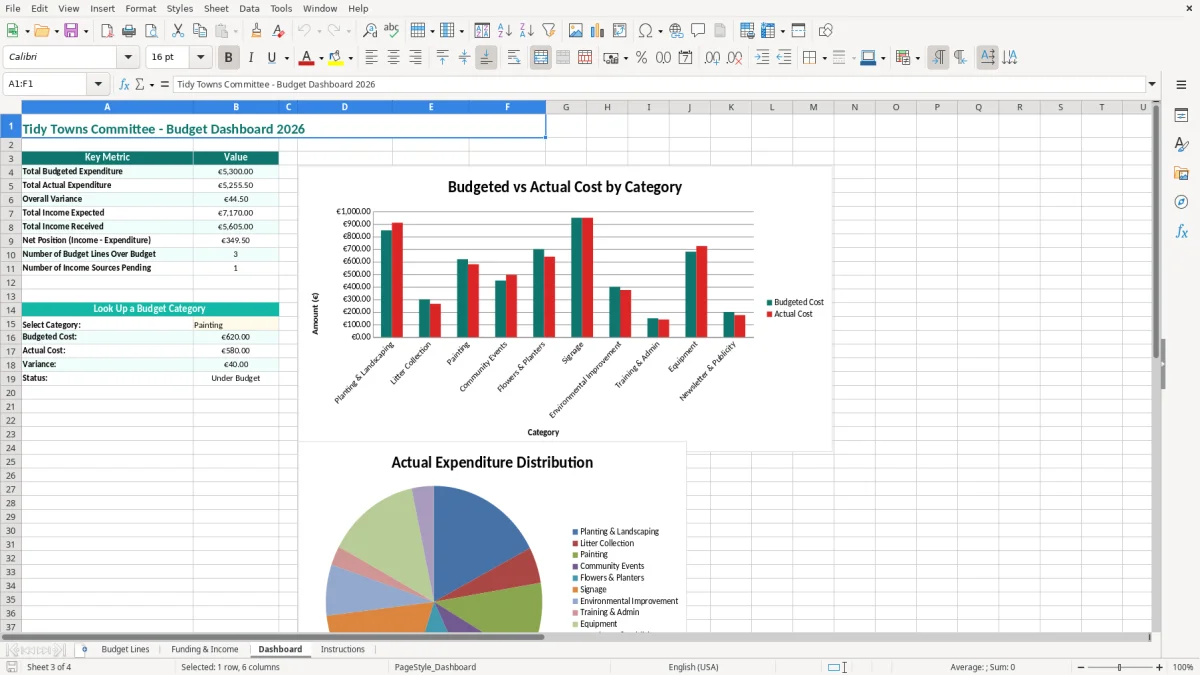
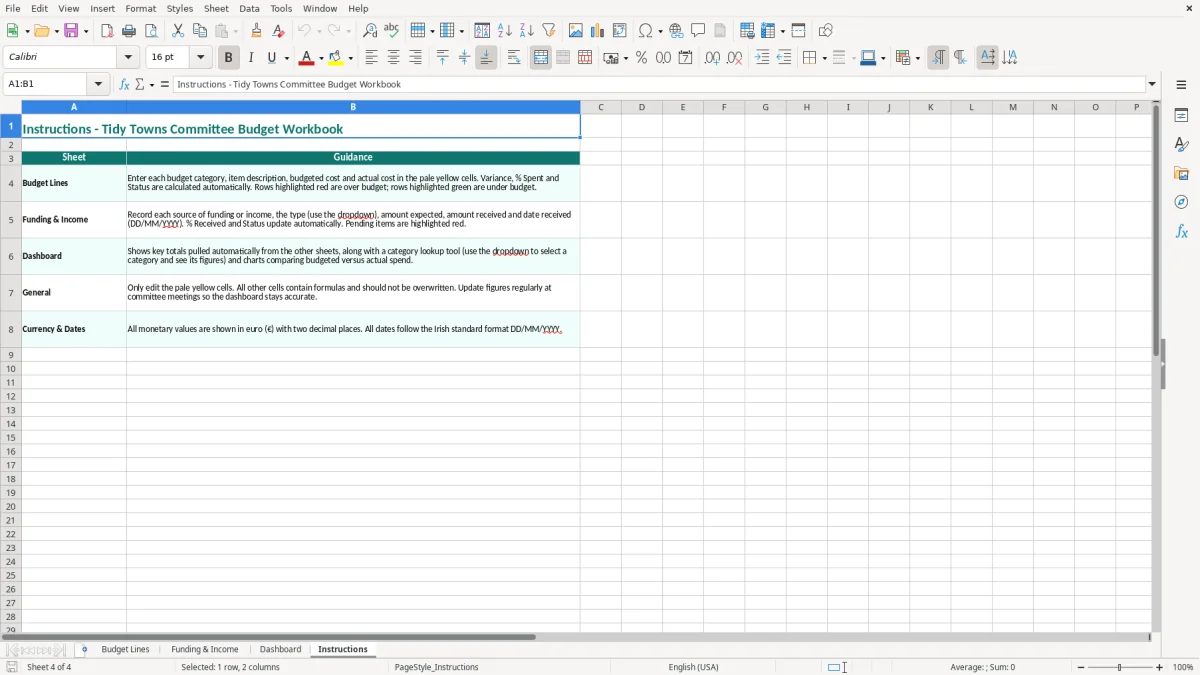
The four sheets are Budget Lines, Funding & Income, Dashboard and Instructions. Image 1 shows the main budget table with teal headings and euro-formatted figures; the later images show the income and funding entry area, the visual summary and the guidance sheet.
A Tidy Towns treasurer usually opens the workbook when the committee agrees its spring plan, then updates it after each clean-up day, planting order, painting job or community event. It is particularly useful when several volunteers spend money from different envelopes or bank cards and one person needs to bring the figures together for the monthly meeting.
Image 1 shows the Budget Lines sheet in a practical committee layout. The eight columns run from Category and Item Description through Budgeted Cost, Actual Cost, Variance, % Spent, Status and Notes. That structure suits a volunteer who knows the work by project rather than by formal bookkeeping codes.
Suppose a committee approves €850.00 for spring bedding plants, €300.00 for litter-picking supplies and €620.00 for painting railings and benches. The total planned spend is €1,770.00. If the actual orders come to €910.50, €265.00 and €580.00, the combined spend is €1,755.50, leaving €14.50 across those three lines even though planting itself is €60.50 over budget.
That distinction matters. A committee may have money left overall while one project has already used more than its approved allocation.
The Funding & Income sheet, shown in image 2, gives the treasurer a separate place to record money coming in. Use it when a local authority grant, shop sponsorship, church-gate collection or coffee morning is confirmed, rather than mixing income into the cost list.
Image 3 shows the Dashboard used for a quick report. A committee with 25 budget lines can discuss the chart and exception lines in five minutes, then use the detailed sheet for questions. Image 4 contains the Instructions sheet, which is useful when the treasurer changes during the year or a second volunteer helps with updates.
The same weekly totals can be carried into a collection record sheet when the treasurer needs to track church-gate collections and other income separately from the budget lines.
This workbook is a management record, not a substitute for the documents behind each figure. For every significant purchase, keep the supplier invoice or receipt, evidence of payment and, where relevant, the grant approval or sponsorship agreement. The committee should be able to explain why a €495.00 event cost exceeded a €450.00 estimate.
Revenue record-keeping rules require records to be retained for 6 years where they relate to a taxable business or Revenue matter. A purely voluntary Tidy Towns committee is not automatically carrying on a VAT business, but the safe working practice is to retain the workbook and supporting financial records for at least 6 years, especially where public funding is involved.
The Irish standard VAT rate is 23%, with reduced rates of 13.5% and 9%, zero-rated supplies and exempt supplies also existing. A committee should not assume that every quoted price can be reclaimed: VAT recovery depends on the committee's status, the nature of the activity and the records supporting it.
If the committee itself makes taxable supplies, the VAT registration thresholds are €37,500 for services and €75,000 for goods. Registered traders generally submit a bi-monthly VAT3 return and an annual Return of Trading Details through ROS. Most local voluntary committees will not be near those thresholds, but a paid service or trading activity should not be hidden inside a fundraising total.
For a grant-funded line, record the award, conditions and amount received on Funding & Income, then match invoices to the relevant project. For example, if a €2,000 grant supports planting and the committee spends €1,650.00, the Dashboard should make the remaining €350.00 visible rather than treating it as unrestricted cash.
Names, phone numbers and bank details of volunteers are personal data under GDPR. Limit access to the treasurer and authorised officers, avoid placing PPS numbers in this workbook and delete obsolete contact information in line with the committee's retention policy.
The most expensive mistake is often not a dramatic overspend. It is a small purchase that is never attached to the right project, so the committee believes there is money available when the balance has already been committed elsewhere.
A volunteer buys €86.40 of gloves and bags, another pays €142.00 for paint and the chairperson uses a personal card for €64.50 of plants. If those three receipts arrive at the end of the summer, the litter and painting lines can each look understated by more than €200.00. The issue is not just presentation: the committee may approve another order and exceed its bank balance.
Enter actual costs from checked invoices, not from memory. The Notes column is the right place to identify a bulk order, reimbursement or supplier so that a second volunteer can trace the figure.
Suppose the committee receives €3,000.00 for a streetscape project but records all income as one fundraising total. It then spends €2,400.00 on planters and €900.00 on an unrelated event. The bank account still shows €2,700.00 from the original receipt, but the restricted project has been overspent by €300.00.
That is why I prefer project categories and a separate Funding & Income record rather than one broad line called committee expenses. The Dashboard can show the overall position, while the notes preserve the reason for a difference.
Prices for plants, timber, paint and waste collection can move during the year. A €700.00 estimate for six planters becomes €640.00 in the sample budget, while a €450.00 launch event becomes €495.00. Without updating Actual Cost, the percentage spent is meaningless and the committee loses the chance to reallocate €60.00 or control a €45.00 overspend.
Do not delete an old line simply because the work was cancelled. Mark its Status and explain the decision in Notes. Deleting it removes the audit trail the treasurer needs when comparing the approved plan with the final result.
A spreadsheet works when updating it is attached to something the committee already does. Set a fixed monthly review, ideally two or three days before the committee meeting, and ask one person to collect receipts while the treasurer enters the figures. A 20-minute routine is more useful than a two-hour catch-up in October.
For example, if 18 lines take 45 seconds each to check, the data-entry part is about 14 minutes. That is realistic before a monthly meeting; reconstructing 18 lines after six months is not.
Use the same category names every time: Planting & Landscaping should not become Plants in one row and Landscaping in another. Copy the previous month’s working file only after saving the approved version, and use the Instructions sheet when another volunteer takes over.
My preference is to keep this workbook for a small committee with perhaps 20 to 60 annual budget lines. Once there are several bank accounts, hundreds of transactions, payroll, stock or restricted grants requiring detailed reports, move to bookkeeping software and keep this Dashboard as a committee summary rather than forcing Excel to become a ledger.

 Excel template built and verified by Ciara Byrne, Chartered Accountant (ACA) · builds the Excel templates.