
GLAS Payment Tracker Excel Template Ireland
6
Free download
Irish CGT disposal calculator with acquisition, sale, relief and gain summary sheets for self-assessment and records.
Download template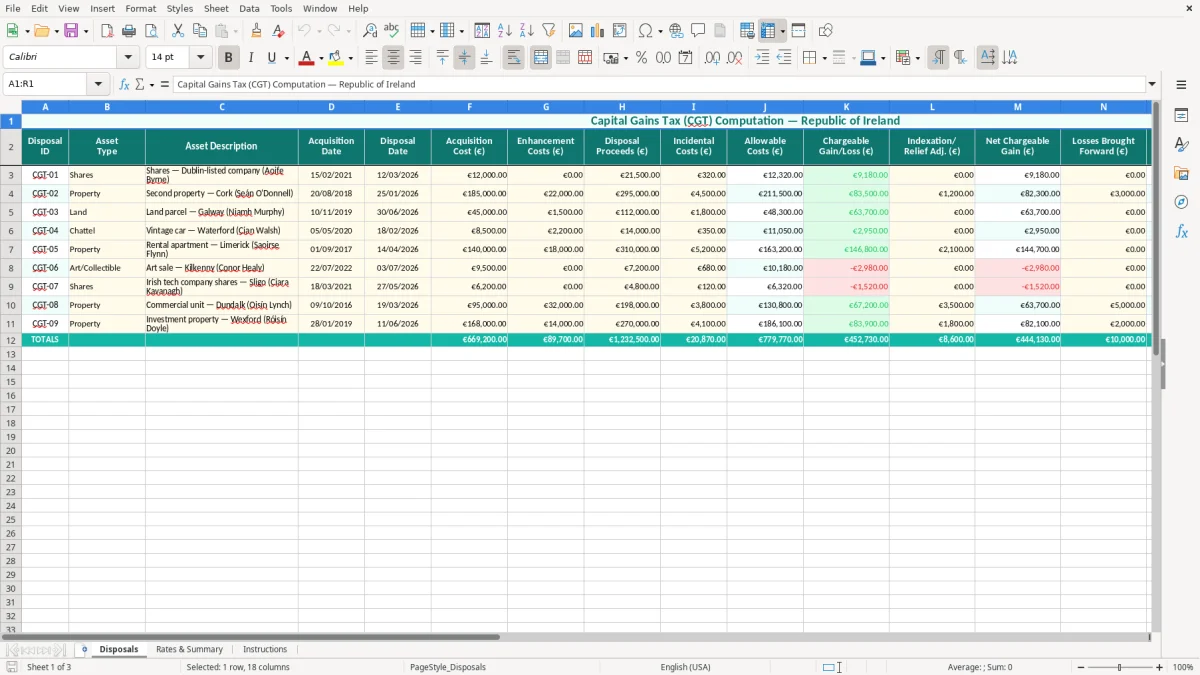
This Capital Gains Tax CGT Excel spreadsheet is a worked calculator for Irish disposals. It helps you capture acquisition cost, sale proceeds, reliefs and the final chargeable gain in one place.
The workbook has three sheets: Disposals, Rates & Summary, and Instructions. You can use it for a one-off asset sale, a batch of disposals, or a year-end check before filing.
If you are dealing with a property sale, shares, or another chargeable asset, this is the simple way to keep the numbers in order before you calculate the tax due.
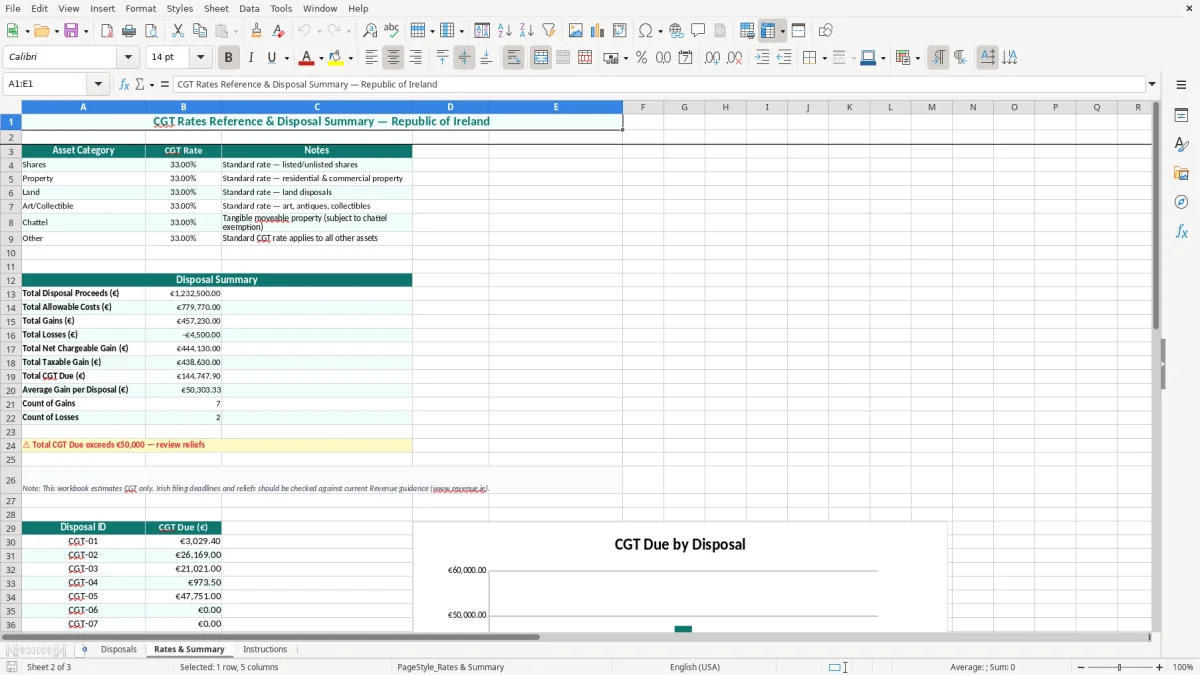
This kind of spreadsheet is for the person who has sold something with a potential gain and wants the figures straight before they move on. In practice that means a private investor selling shares, a landlord disposing of a rental property, a sole trader selling a van, or a family sorting the gain on a second property.
The direct use case is simple: you need to know the acquisition cost, the disposal proceeds, the fees and the final chargeable gain. A sale of shares for €18,000 that were bought for €12,500, with €250 in brokerage and legal costs, is not something you want to do from memory.
Most people reach for a CGT sheet when there is a disposal in the year and they need a clean figure before the Form 11 work starts. That is especially true if you have more than one disposal, or if one gain has to be set against another loss.
A bookkeeper in a small company might use it at year end to check a shareholder disposal, while a landlord or part-time investor may use it once or twice a year. If you are dealing with a house sale, a share sale and a small asset disposal in the same tax year, a spreadsheet keeps the trail together instead of leaving you with scattered emails and solicitor statements.
Say you sold shares for €32,000 that originally cost €21,000, with €180 in dealing fees and €120 in legal or transfer costs. The spreadsheet shows the gain starting at €10,700 before any reliefs or exempt amounts are applied.
That is the point of the sheet: not to be clever, but to stop you missing a cost that reduces the gain. On a disposal of this size, a missed €500 cost line can change your tax bill by more than €100 at the current CGT rate.
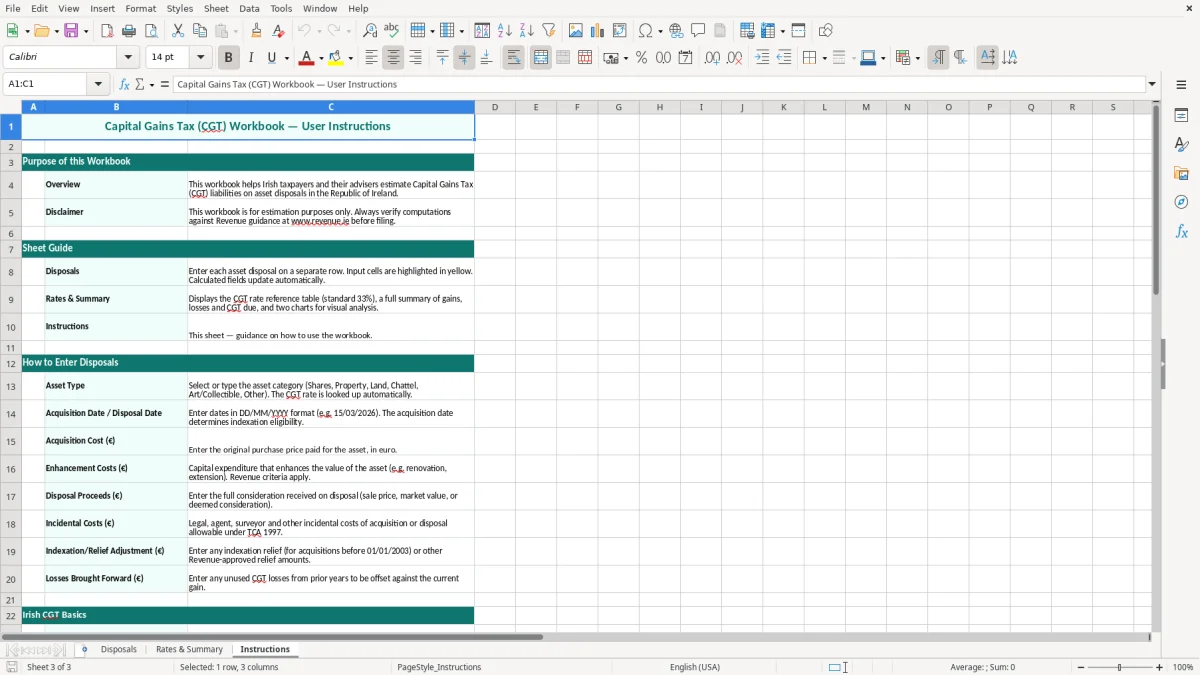
In Ireland, capital gains tax is normally charged at 33% on chargeable gains. The spreadsheet is built to support the arithmetic around that figure, not to replace the tax rules themselves.
For individuals, the annual CGT filing and payment date is 15 December for gains made from 1 January to 30 November, with the 31 January filing date for gains in December. That timing matters because a disposal in late autumn can create a cash flow problem if you leave the calculation too late.
Revenue expects you to keep records for 6 years, so the supporting papers behind each disposal need to be stored with the spreadsheet. That means the contract, broker statement, solicitor invoice, bank transfer and any valuation evidence for assets that were acquired without a straightforward purchase price.
If you sell a shareholding through a broker, the acquisition and disposal dates, the quantity, the cost base and the fees all need to line up. For a small gain of €6,000, CGT at 33% is €1,980 before any losses or reliefs, so even a modest input error has a real cost.
A basic spreadsheet is still the simplest way to track one-off disposals, especially for sole traders and private investors who do not need a full tax system. If you have two disposals in a year, one gain of €8,000 and one loss of €3,000, the sheet makes the offset obvious and leaves you with a net gain of €5,000 to carry into the tax calculation.
The practical stance here is straightforward: use the spreadsheet for the calculation and the evidence trail, then transfer the final figure into your tax return or adviser’s schedule. That is cleaner than trying to calculate CGT in a notebook and reconstruct it months later.
The most common mistake is leaving out costs that should be part of the disposal calculation. Broker fees of €50, legal fees of €400, or valuation costs on a property sale are easy to miss, and every missed euro leaves the gain too high.
Another problem is mixing up the acquisition and disposal dates, especially where the asset was bought years ago and the papers were filed away. If you use the wrong date, you can misread the tax year and miss the 15 December payment date for the disposal.
A missed loss can be even worse than a missed cost. If you disposed of one asset at a €9,000 gain and another at a €4,000 loss, failing to capture the loss means you overstate taxable gain by €4,000 and overpay CGT by €1,320 at 33%.
People also forget that a spreadsheet is only as good as the supporting documents behind it. If you sell shares for €27,500 and cannot show the broker statement, bank record and original cost, you can spend hours rebuilding the figures and still end up with a weak audit trail.
In workshop settings, the other frequent issue is putting everything into one line when the disposal should be split. A part sale of shares, or a property sale with separate legal and agent fees, needs the detail kept separate or the gain becomes hard to defend later.
The simplest fix is to enter each disposal on its own row and attach the evidence outside the sheet. That way, when you return to it six months later, you are not trying to remember why a total looked right at the time.
That same row-by-row split also makes it easier to carry the numbers into corporation tax workings when the disposal feeds a company return.
The best way to make this stick is to use it as soon as a disposal happens, not after the year is over. If you wait until the Form 11 deadline is close, you will be chasing old contracts and half-remembered fees instead of checking figures calmly.
For most people, the neatest routine is to update the sheet the same week the sale completes. That works whether you have one share sale or three asset disposals, and it keeps the paperwork close to the event.
If you have dozens of trades, multiple share classes or frequent disposals, you may need a more formal system or adviser support. For a small number of Irish disposals in a year, though, this spreadsheet is usually the most practical option because it is fast, readable and easy to file away with your records.
For disposals that no longer fit a simple tracker, the next step is often to carry the figures into a Form 11 return.

 Excel template built and verified by Ciara Byrne, Chartered Accountant (ACA) · builds the Excel templates.