
GAA Club Subs Tracker Excel – Free Template (2026)
6
Free download
Track CAT gifts, inheritances, thresholds and tax due in Ireland with a simple dashboard and threshold guide.
Download template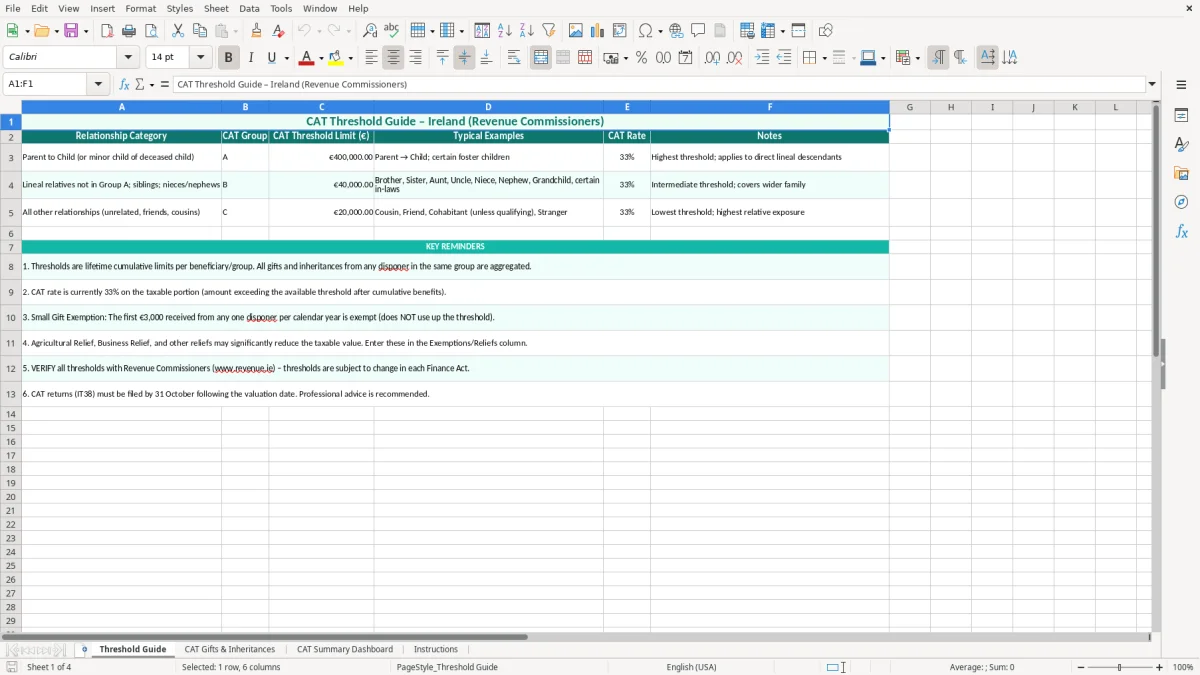
This CAT Threshold Tracker Excel template helps you track Capital Acquisitions Tax gifts and inheritances in Ireland, match each beneficiary to the right threshold group, and estimate the tax due. It includes a Threshold Guide, CAT Gifts & Inheritances, a CAT Summary Dashboard and Instructions.
Use it when you are planning a gift, reviewing an estate, or checking whether a payment will push a beneficiary over a lifetime threshold. The sheets are laid out so you can see the total benefits received, the remaining threshold and the estimated tax in one place.
It is built for the practical work people actually do: a parent helping a child onto the ladder, a solicitor or executor reviewing an estate, or a family member trying to work out whether the next €20,000 gift matters. The workbook keeps the figures together instead of leaving you to juggle calculator notes and email chains.
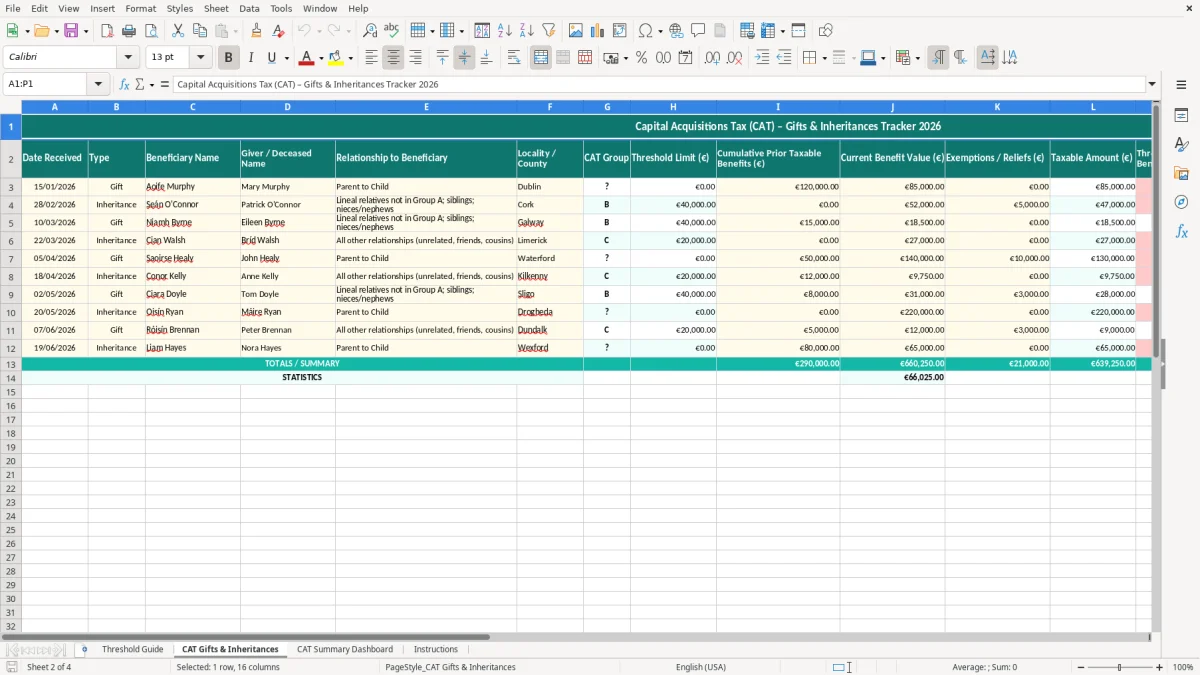
This template is for the people who end up doing the real CAT checking: a parent making lifetime gifts, an executor dealing with an estate, a solicitor’s office preparing papers, or a family member trying to understand a notice from Revenue. It is most useful when a transfer has just happened, or when several gifts have built up over a few years and you need to see the total.
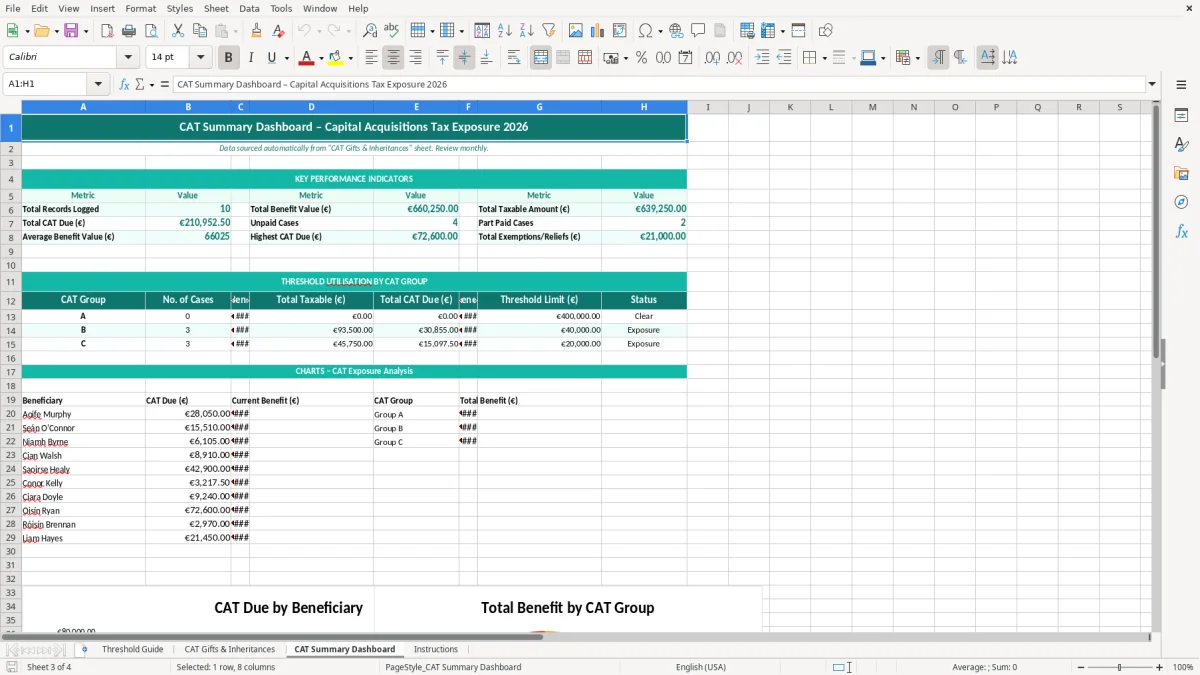
The screenshots show the workbook in four parts. Image 1 is the Threshold Guide, image 2 is the CAT Gifts & Inheritances sheet, image 3 is the CAT Summary Dashboard, and image 4 is the Instructions sheet.
A typical case is a parent giving a child €60,000 now and another €40,000 next year. On paper those feel like ordinary family help, but the tracker makes it obvious that the lifetime total is moving through the Group A limit of €400,000, not sitting as isolated payments.
Take three siblings each receiving €18,000 from an aunt. That is €54,000 across the family, but the limit issue lands on each recipient separately under Group B or Group C depending on the relationship. This is exactly the sort of split that gets missed when people try to manage CAT by memory and a bank statement.
That same family-by-family tracking becomes easier when the figures also need to be reconciled against a trading details return, where each payment is tied back to the right recipient and year.
In Ireland, Capital Acquisitions Tax applies to gifts and inheritances received on or after 05/12/2001, and the current rate is 33%. The key threshold groups in the guide are Group A €400,000, Group B €40,000 and Group C €20,000, and those limits are what drive the calculation in the workbook.
Revenue expects you to keep records for 6 years, which is why the template has a proper line-by-line sheet instead of just a summary cell. If a child receives €430,000 from a parent, the excess over Group A is €30,000, so the rough CAT exposure is €9,900 at 33% before you deal with any reliefs or exemptions that may apply.
The practical rule is simple: Group A is for the direct lineal relationship, Group B covers many nearer collateral relationships such as siblings, and Group C is the smallest threshold for everyone else. Put the wrong relationship into the wrong group and your tax estimate can be miles off, even if the euro figure itself is accurate.
If CAT becomes payable, the return is filed through ROS and the filing and payment date is linked to the valuation date, which is why recording the date of each benefit matters. A tracker like this is much better than a loose note on a phone because the dates, amounts and relationship category stay together in one place.
The same deadline discipline applies when you move from CAT to corporation tax, where a CT1 workings sheet keeps the figures and dates aligned for ROS filing.
The biggest problem I see is people treating a series of gifts as if each one starts from zero. A beneficiary who receives €15,000 this year, €20,000 next year and €25,000 after that may already be well into a threshold long before anybody notices, and the missed tax can run into thousands.
Another common failure is using the wrong relationship category. If a niece is tagged as Group B when she should be in Group C, the threshold difference is €20,000 versus €40,000, and that can change the CAT calculation sharply on a modest estate.
If you understate a taxable benefit by €30,000, the tax at 33% is €9,900. Add the time spent reopening paperwork, checking valuations and correcting the return, and a mistake that looked small can eat a weekend and a fair bit of goodwill.
Loose notes and separate spreadsheets are where people lose the thread. When one family member has the bank transfer, another has the solicitor letter and a third has the valuation, the figure may be right in pieces but wrong as a whole.
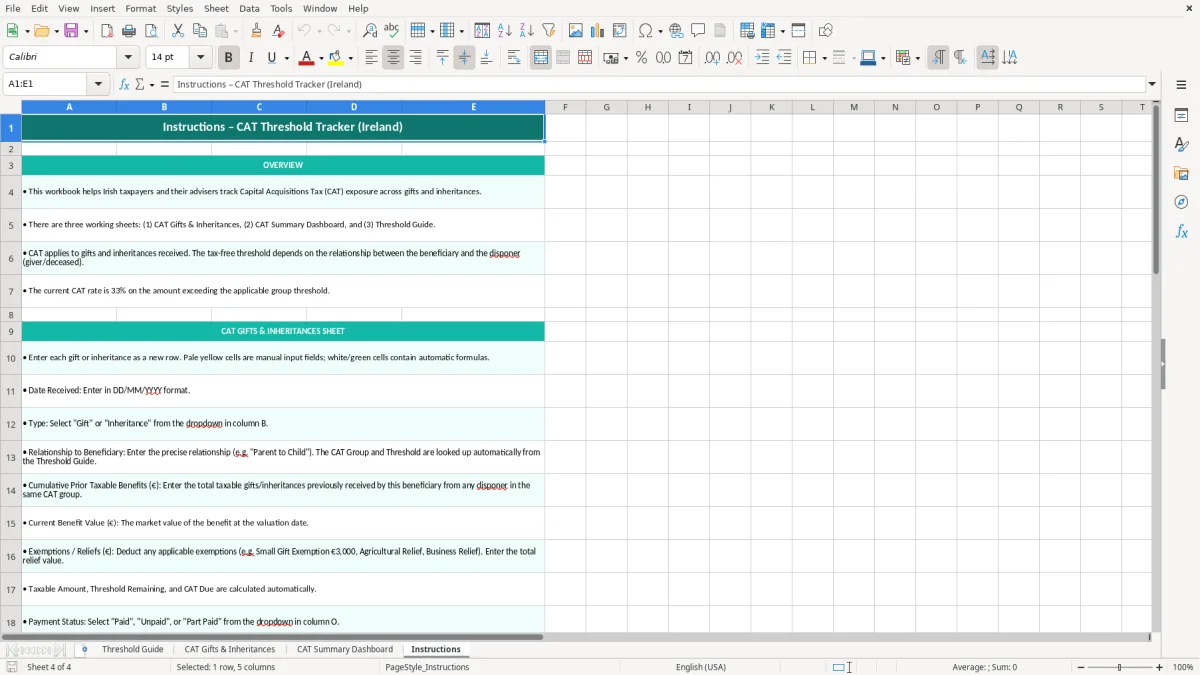
Use the workbook every time a gift is made or an estate update arrives, not just at year end. The best habit is to open it as soon as the transfer is agreed, then add the details before the money disappears into normal household spending.
For a family that gives €5,000 a year for 8 years, that is €40,000 in total. A simple routine stops you from discovering the threshold issue only when the recipient is already close to the limit and the filing work is harder.

 Excel template built and verified by Ciara Byrne, Chartered Accountant (ACA) · builds the Excel templates.