
School Book Rental Excel Template – Free Tracker (2026)
0
Free download
Track Irish co-op milk deliveries, milk solids, quality bonuses, effective prices, estimated payments and target achievement in Excel.
Download template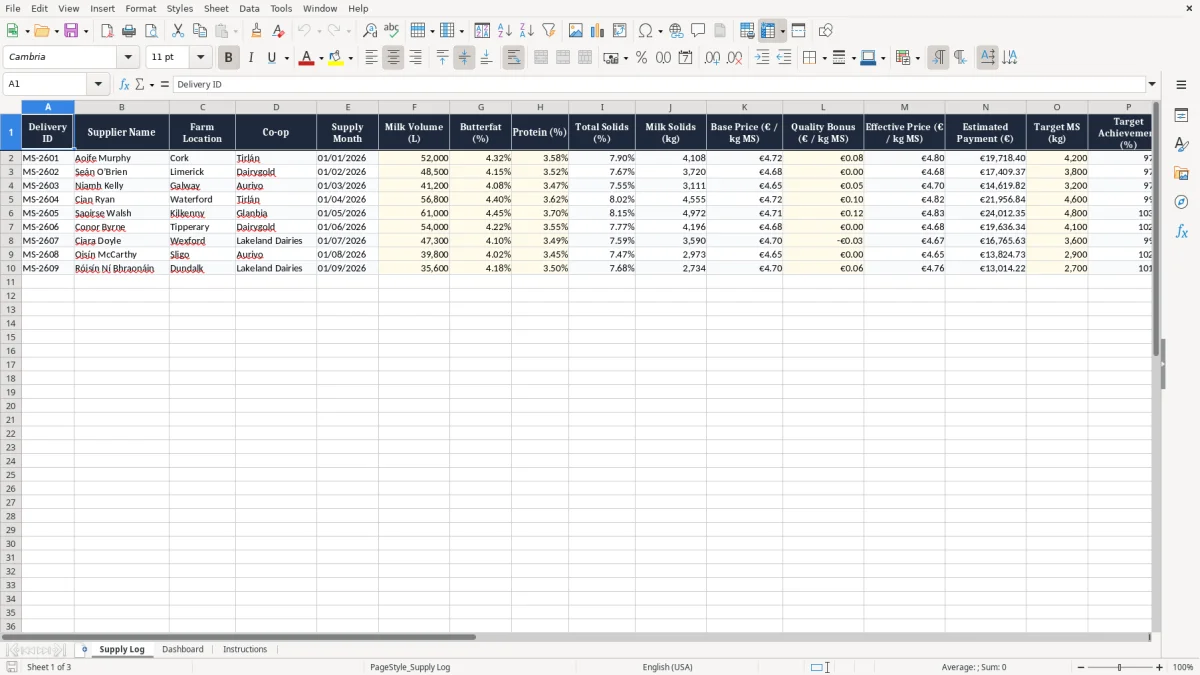
This practical Excel template helps Irish dairy farmers, farm offices, agricultural advisers and co-op supply teams record monthly milk deliveries and understand milk solids performance. Capture supplier, farm, location, co-op, volume, butterfat and protein information in one structured supply log. The workbook also supports standard co-op base prices, quality bonuses or deductions, effective milk solids pricing, estimated payments and target comparisons.
Sample records represent Irish locations and co-ops such as Tirlán, Dairygold, Aurivo, Glanbia and Lakeland Dairies. Replace the illustrative figures with your own collection records, laboratory results, payment statements and agreed pricing information.
Start by replacing the sample rows with your own delivery or monthly supply records. Enter the delivery ID, supplier name, farm location, co-op and supply month, then add milk volume in litres and the butterfat and protein percentages shown on the relevant co-op or laboratory statement. Review the calculated total solids and milk solids values.
Update the co-op lookup information with current standard base prices, then enter any quality bonus or deduction applicable to the period. Add a target milk solids figure where you want to measure performance.
Use the effective price, estimated payment and target achievement fields to review results, and add notes for seasonal changes, collection issues or statement adjustments. Check all calculations against official co-op statements before using the workbook for financial decisions.
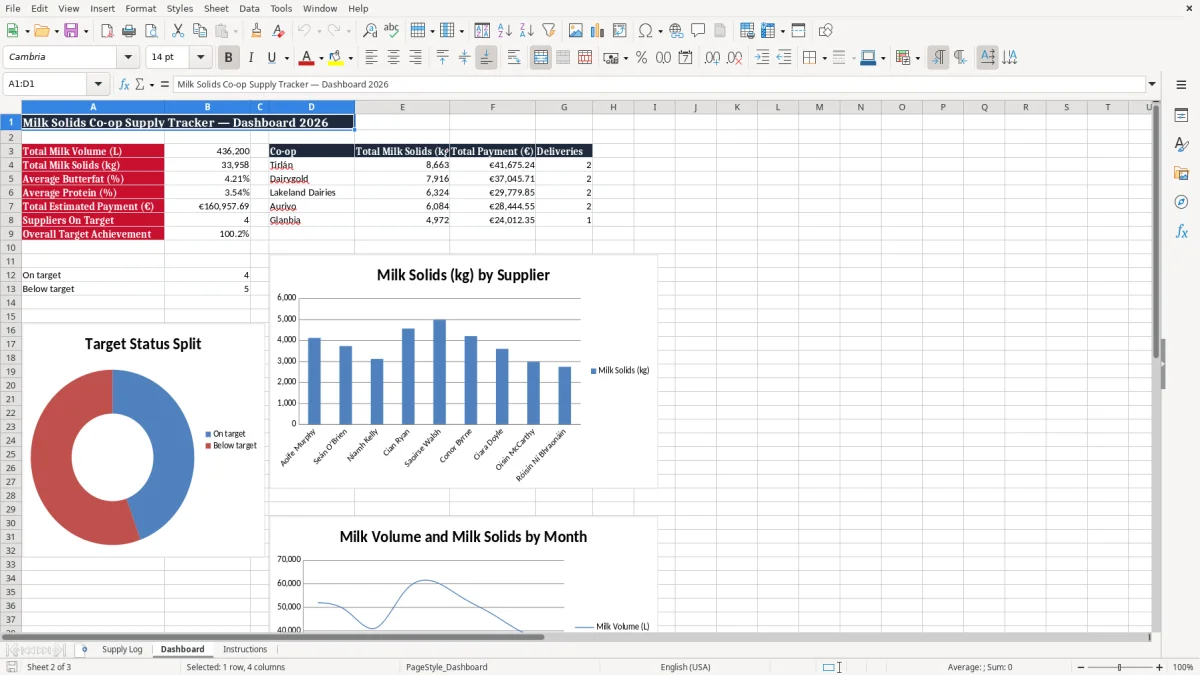
Milk supply records can become difficult to manage when delivery information, laboratory results, co-op pricing and payment estimates are kept in separate notes or statements. This Irish milk solids co-op supply tracker brings those details together in a clear Excel worksheet. It is designed for monthly monitoring, but the same structure can be adapted for individual collections, farm groups or longer annual supply records.
Each row identifies a delivery or reporting period and includes the supplier, farm location, co-op and supply month. This makes it easier to filter records by farm, supplier, region or co-op when reviewing performance.
The template uses examples from Irish dairy locations including Cork, Limerick, Galway, Waterford, Kilkenny, Tipperary, Wexford, Sligo and Dundalk. Example co-ops include Tirlán, Dairygold, Aurivo, Glanbia and Lakeland Dairies.
These records are included to demonstrate how the tracker can be populated and should be replaced with current farm and payment information. The spreadsheet is suitable for individual farmers who want a straightforward management record, as well as advisers or administrative teams who need a consistent format across several suppliers.
Using one structured log can improve visibility over seasonal changes in milk volume and solids. It can also help users prepare questions for a co-op, reconcile records with payment statements and spot missing information before a monthly review. The tracker is not intended to replace official statements or contractual calculations.
Instead, it provides an organised planning and monitoring tool that supports clearer comparisons between supply periods and helps keep important operating information in one accessible Excel file. Accurate records can make routine reviews faster and give users a more dependable basis for discussing production, quality and payments with relevant advisers or co-op contacts.
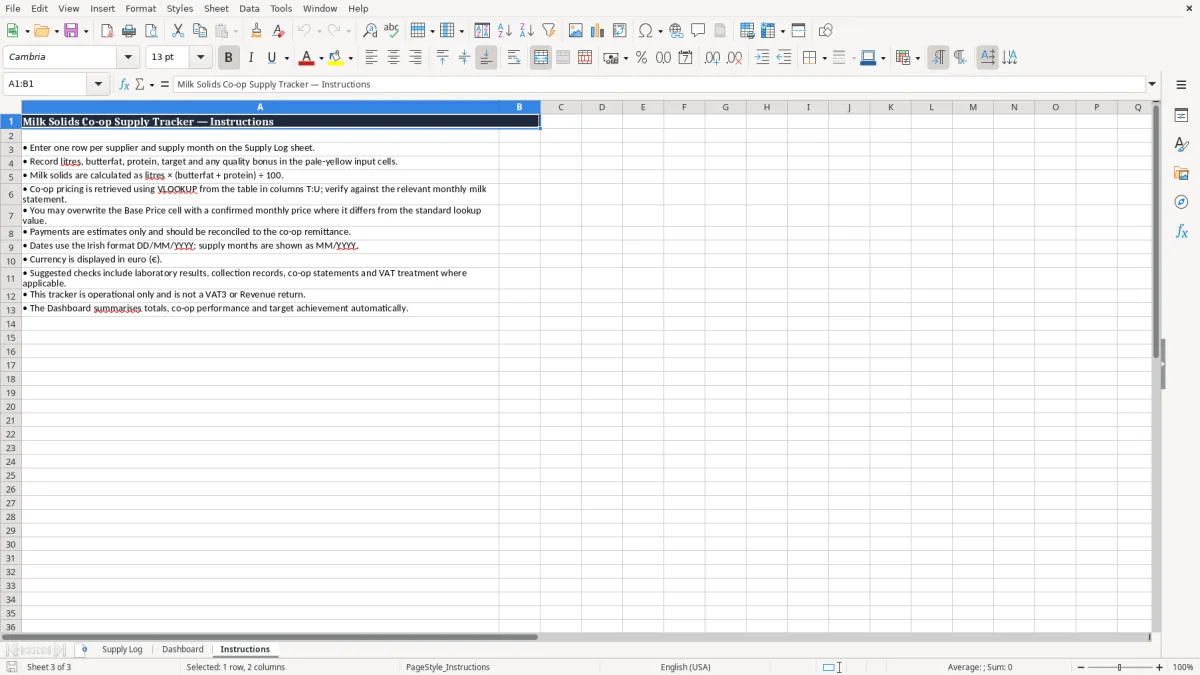
Milk volume alone does not show the full value or composition of a dairy supply. Butterfat and protein percentages are important inputs when reviewing milk solids, and this template provides dedicated fields for both measures.
Enter the figures from the appropriate co-op statement, collection report or laboratory result, then use the calculated solids fields to review the estimated kilograms of milk solids supplied. Total solids combines the relevant composition percentages, while milk solids uses the recorded volume and solids percentage to create a practical kilogram measure.
Monitoring these indicators over time can help reveal seasonal patterns. Spring grazing, weather conditions, feed changes, herd composition and management decisions may influence volume, butterfat and protein.
A month with lower litres may still produce a useful level of milk solids if composition is stronger, while a high-volume period may require closer review if solids percentages fall. The tracker gives users a consistent place to compare those changes without relying on memory or scattered paperwork.
For best results, enter data exactly as shown on the source statement and use consistent units throughout the workbook. Milk volume is recorded in litres, composition is recorded as a percentage and milk solids are expressed in kilogrammes. Check whether a co-op statement reports figures as averages, weighted results or another basis before making comparisons.
The spreadsheet provides estimates for management use, so users should confirm the underlying formula assumptions and reconcile the output with official figures. Accurate data entry is particularly important when comparing suppliers or assessing performance against a target. Used alongside farm records and co-op documentation, the template can support more informed monthly supply reviews and help explain why results change from one period to the next.
Milk pricing can include a standard base price together with quality bonuses, deductions or other adjustments. The tracker includes separate fields for base price and quality adjustment, allowing users to see how those components contribute to an effective price per kilogram of milk solids.
Positive entries can represent bonuses, while negative entries can represent deductions. The estimated payment field then provides a planning figure based on the milk solids supplied and the effective price entered for the period.
A supporting lookup area contains example standard base price values for Irish co-ops. These values are included for demonstration only and must be updated to match current contracts, statements or confirmed payment schedules. Co-op pricing may vary by month, scheme, protein or butterfat measure, quality result, volume arrangement, collection terms and other conditions.
Some statements may also include charges or adjustments that are not represented by a simple base price and bonus structure. Users should therefore treat the spreadsheet output as an estimate rather than a definitive payment calculation.
The pricing section is useful for comparing expected results with received statements. After a payment is issued, enter or confirm the applicable figures and use the notes field to record differences, explanations or follow-up actions. This can support administration, budgeting and discussions with an adviser or co-op representative.
It may also help identify a missing bonus, an unexpected deduction or an outdated lookup value. Always verify the currency, unit basis and timing of each price before comparing records. The workbook is designed to make assumptions visible and editable, helping users maintain a clearer audit trail while recognising that official co-op documentation remains the authoritative source for final payment values and contractual interpretation.
A target can make monthly supply information more useful by showing whether actual milk solids are meeting expectations. Enter a target milk solids figure for the relevant supplier or period, then review target achievement as a percentage.
This creates a simple performance measure that can be used for monthly planning, seasonal comparison or internal reporting. The status field and notes area can add context, such as a completed collection, a weather-related reduction, a quality deduction or a strong spring supply period.
Targets should be realistic and clearly defined. They may be based on historical farm performance, a production plan, a co-op supply commitment or an internal budgeting assumption. Users should record whether the target refers to a month, a delivery, a quarter or another reporting period, and apply the same basis consistently.
If circumstances change, update the target and explain the reason in the notes field rather than silently replacing an earlier assumption. This helps preserve context when the workbook is reviewed later.
The tracker can support regular review meetings by showing volume, composition, milk solids, price and payment estimates together. It may be useful to filter for periods below target, compare co-ops or locations, and investigate whether a change came from litres, butterfat, protein or pricing adjustments. It should not be used as a standalone agronomic, financial or contractual decision tool.
Actual results depend on the quality of source data and the rules applied by the relevant co-op. Confirm unusual results with the original statement or an appropriate adviser. With consistent updates, the spreadsheet provides a practical record for understanding supply trends, planning future reviews and documenting the operational reasons behind changes in performance.

 Excel template built and verified by Ciara Byrne, Chartered Accountant (ACA) · builds the Excel templates.