
GAA Club Subs Tracker Excel – Free Template (2026)
6
Free download
Estimate the 2026 Irish Home Carer Tax Credit using carer income, spouse income, household details and the €1,950 maximum credit.
Download template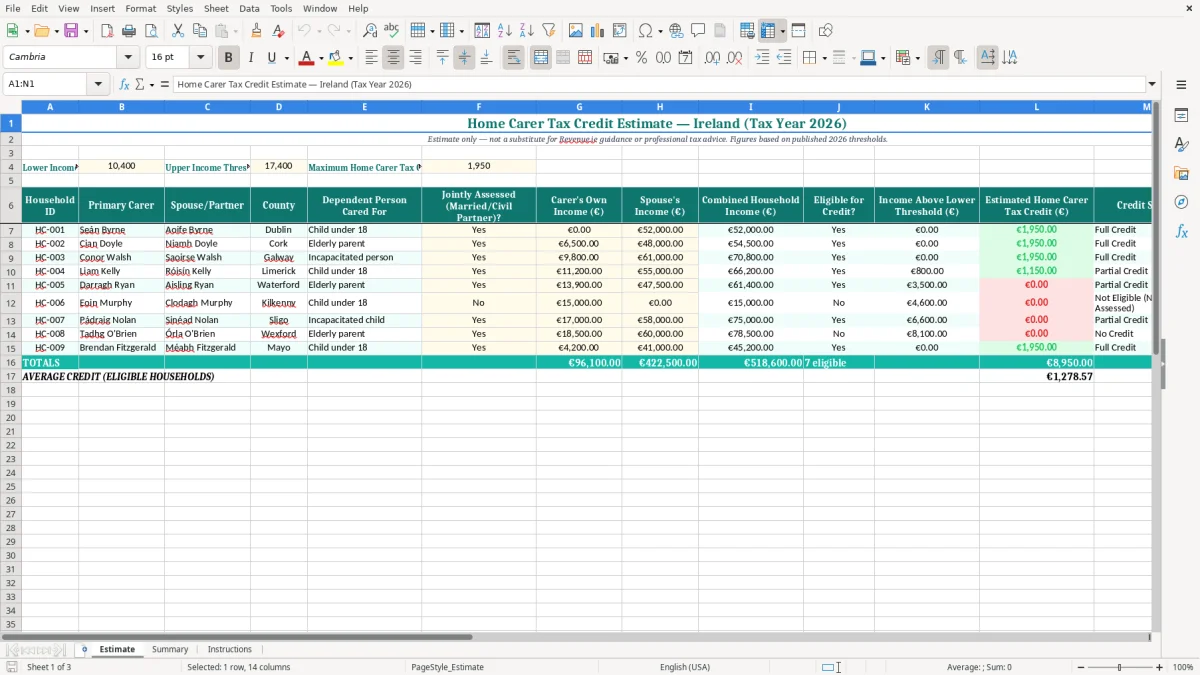
This Home Carer Tax Credit Excel spreadsheet estimates the 2026 Irish tax credit from household and income details. It contains an Estimate sheet for entering each household, a Summary sheet for reviewing estimates and an Instructions sheet explaining how to use the workbook.
The template displays a lower income threshold of €10,400, an upper income threshold of €17,400 and a maximum Home Carer Tax Credit of €1,950. It is an estimate only, so check the final position with Revenue before making a claim.
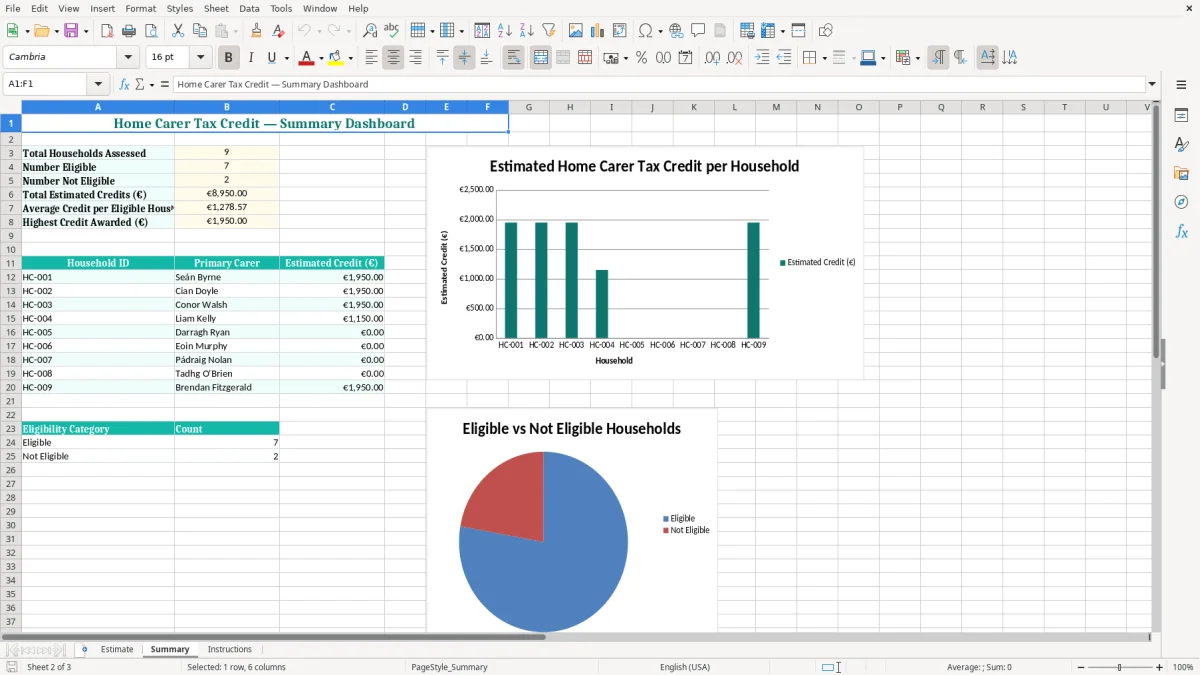
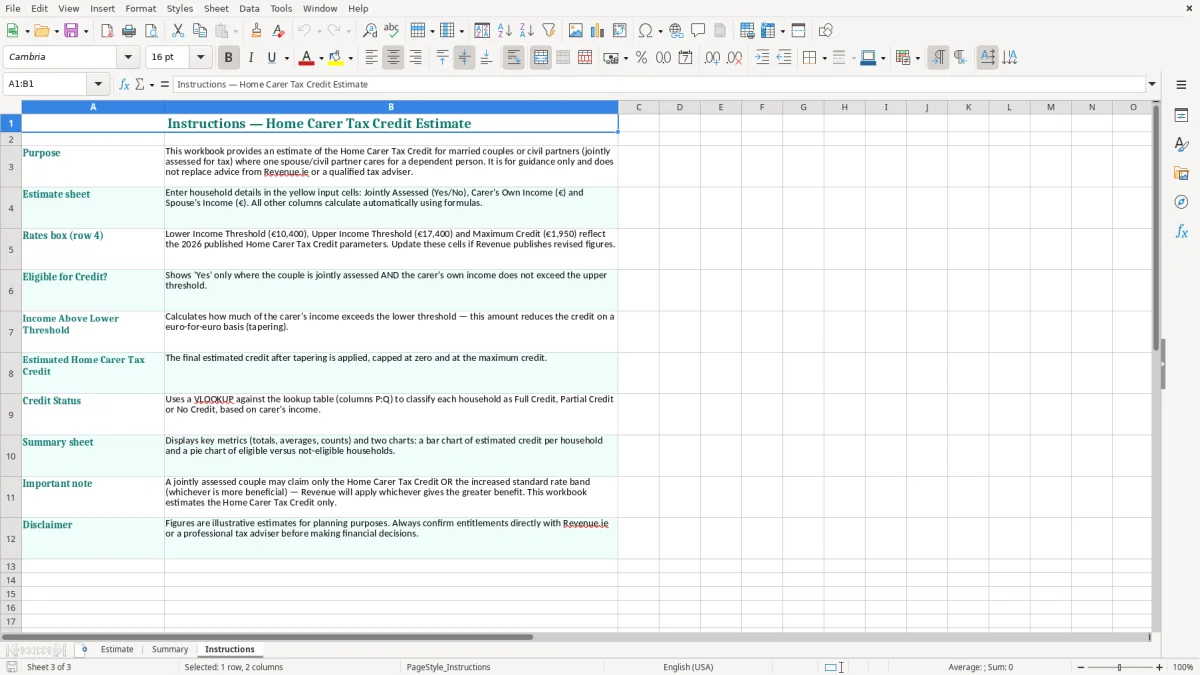
Image 1 shows the Estimate sheet with the three threshold boxes and household input table. Image 2 shows the Summary sheet, and image 3 shows the Instructions sheet.
This spreadsheet is useful for a jointly assessed couple checking whether the Home Carer Tax Credit may apply, particularly where one spouse has reduced paid work to care for a child or dependent relative. It can also help a payroll administrator, community advice worker or bookkeeper prepare a first-pass estimate before the household checks its position with Revenue.
Consider a married couple in Cork. The primary carer earns €9,800 during 2026 and the spouse earns €58,000. The carer's income is below the template's €10,400 lower threshold, while the spouse's income still needs to be recorded because the couple's tax assessment and liability affect the practical value of a credit.
In another household, the carer earns €14,000 for the year. That figure is €3,600 above the lower threshold and below the €17,400 upper threshold. Entering the figures in the same format gives the couple a consistent estimate to discuss with Revenue instead of relying on a figure remembered from an earlier tax year.
Use the file during an annual tax review, after a spouse returns to work, or when part-time wages, pension income or casual employment changes the household position. A self-employed spouse may review it before the mid-November Form 11 deadline on ROS, while a PAYE couple may check the position through Revenue's PAYE services.
Image 1 shows the Estimate sheet's practical layout: household identity and care details appear before the income fields. The Summary sheet in image 2 is useful when a bookkeeper or advice centre is checking several household IDs together.
The same review is also the point at which a HTB refund estimate can be checked against the updated household figures before the return is filed.
The workbook uses three displayed 2026 assumptions: a lower income threshold of €10,400, an upper income threshold of €17,400 and a maximum Home Carer Tax Credit of €1,950. These figures are the basis of the template's estimate and are not a guarantee that the full maximum can be claimed.
The credit is intended for a jointly assessed married couple or civil partners where one spouse is a home carer for a qualifying dependent person. That is why the Estimate sheet asks whether the household is jointly assessed and records the dependent person cared for. A completed cell does not itself prove that every Revenue condition has been met.
For example, a carer's annual income of €10,400 is exactly at the lower threshold shown in the workbook. Income of €17,400 is at the upper threshold, while €18,000 is above it. Do not enter net bank receipts when the relevant figure is gross income: €14,000 gross pay is not the same as €11,200 received after deductions.
Keep payslips, employment details, pension statements and other records used to calculate both income fields. Revenue generally requires tax and business records to be retained for six years, which is a sensible period for keeping evidence behind an estimate.
The Home Carer Tax Credit is separate from Home Carer's Allowance, which is a social welfare payment. Also remember that a tax credit reduces income tax; it is not automatically a €1,950 cash payment. Check the relevant Revenue guidance and the household's assessment record before submitting or amending a claim.
The first mistake is treating the €1,950 maximum as an automatic payment. A household may appear to qualify from the income entered, but the usable credit is limited by the relevant conditions and the amount of income tax available to reduce. The workbook estimates a tax position; it does not create a refund by itself.
Entering one monthly payslip instead of the full 2026 figure is a frequent error. If a carer earned €900 a month for six months, that employment produced €5,400, not €900 for the year. Add the relevant income for the full tax year and include changes in employment.
Gross and net income are also mixed up. If gross pay is €14,000 and €11,200 reaches the bank after deductions, entering €11,200 understates the income by €2,800. Around a threshold, that error can change the estimate and lead to an unnecessary query with Revenue.
A Yes entry in the jointly assessed field does not confirm that the couple is actually jointly assessed for the relevant year. Likewise, typing a dependent person's name does not replace checking whether the care relationship and other conditions meet Revenue's requirements.
Do not replace the displayed assumptions with figures copied from an old workbook. If a threshold is changed by €100, an estimate close to the boundary may change, while the source of the altered figure may be forgotten. Keep the note beneath the title and retain the Instructions sheet.
The workbook also contains personal data, including income and care information. Store it securely under GDPR principles, restrict access and avoid sending unprotected copies by ordinary email.
The workbook also contains personal data, including income and care information, so the next step is to track the relevant CAT threshold limits securely and keep the figures current.
Use the workbook as part of a fixed annual review rather than opening it only when somebody asks about the credit. Put a reminder in early October, before the mid-November Form 11 deadline on ROS, and gather the year's payslips, pension statements and other income evidence before updating the Estimate sheet.
A single household should take less than 15 minutes to review once the documents are ready. A bookkeeper checking 12 households can prepare six rows at a time, then reconcile each entry to the supporting records before contacting the families about missing information.
This template is suitable for a small number of private estimates. Move to a secure tax or case-management system when several people edit the file, when you need a full audit trail, or when sensitive records for dozens of households are being stored.
Excel is a practical calculation and review register, but it is not Revenue's assessment system. Keep the final submission or claim confirmation separately so the spreadsheet remains evidence of the estimate rather than being mistaken for an official decision.

 Excel template built and verified by Ciara Byrne, Chartered Accountant (ACA) · builds the Excel templates.