
GAA Club Subs Tracker Excel – Free Template (2026)
6
Free download
Track nursing home fees, Fair Deal contributions and Section 469 tax relief for each resident and tax year in this Irish Excel template.
Download template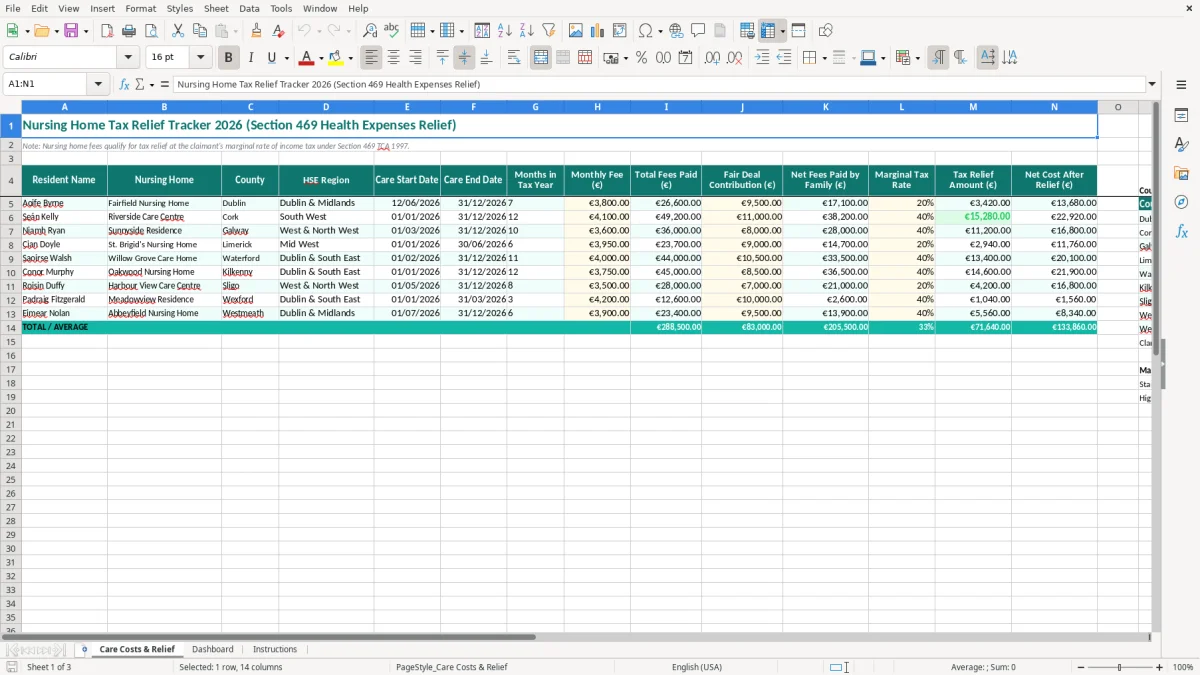
This nursing home tax relief Excel template records care fees, Fair Deal contributions and the family amount paid, then calculates estimated relief under Section 469 TCA 1997 and the net cost after relief. It is designed for Irish families, carers and advisers tracking 2026 health expenses.
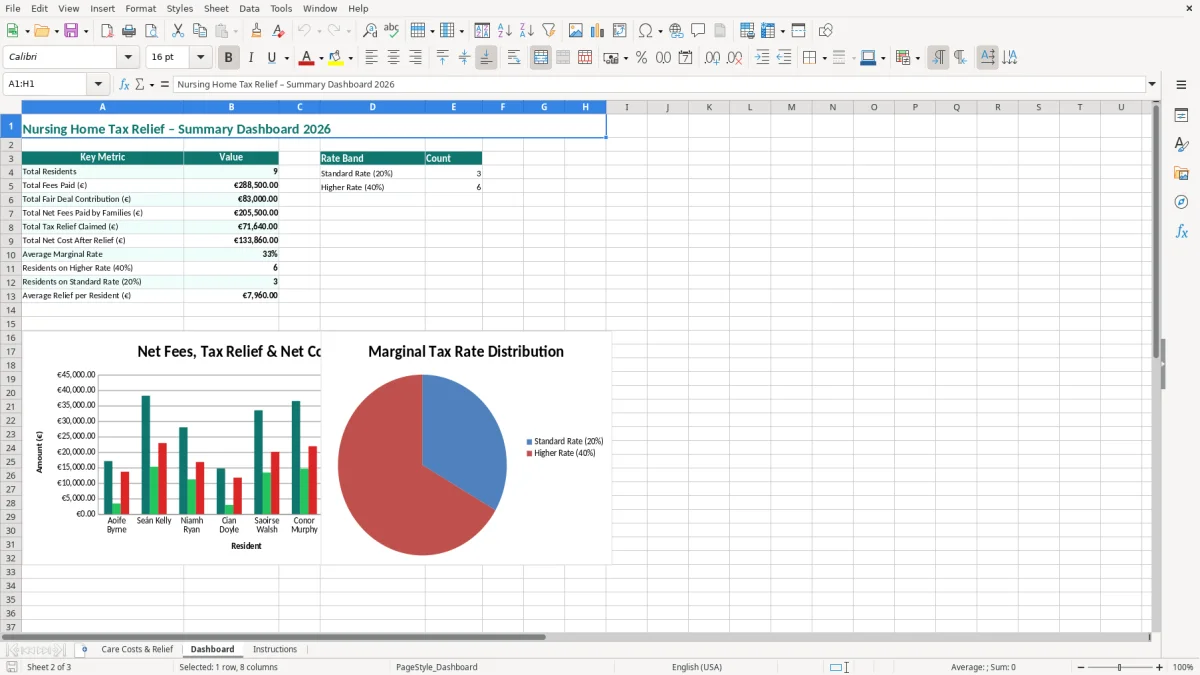
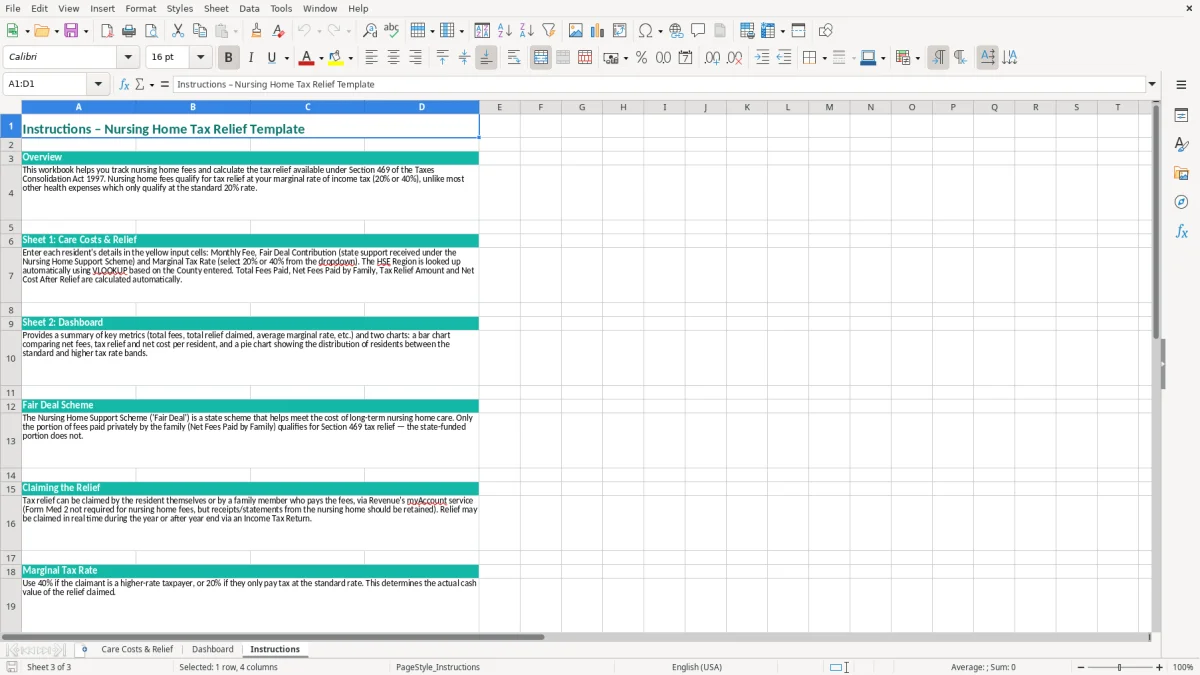
The main Care Costs & Relief sheet contains resident and nursing home details, dates, monthly fees, contributions, marginal tax rate, tax relief and net cost columns. Image 1 shows the teal table layout and pale yellow input cells; the Dashboard in image 2 summarises the figures visually, while the Instructions sheet in image 3 explains the intended entries.
Nursing home costs rarely arrive as one neat annual figure. A family member may be paying the direct debit, the resident may receive a pension, and the Fair Deal contribution may be deducted or paid separately. This workbook gives the person handling the paperwork one row per resident and one place to reconcile those amounts.
A daughter dealing with her mother's care in Cork might update the row after each monthly statement. If care started on 12/06/2026 and continued to 31/12/2026, the sheet can record the seven months included in the 2026 tax year rather than accidentally claiming a full twelve months. At a monthly fee of €3,800, the gross figure would be €26,600 before any contribution is deducted.
The workbook is also useful when preparing an income tax return. A sole trader or PAYE employee who paid a parent's eligible care costs can check the annual total before completing the relevant health expense details. Keep the nursing home's invoices and proof of payment alongside the spreadsheet; the row is a control record, not a substitute for evidence.
A bookkeeper may maintain the file for an elderly couple with two residents, while a private household may use it for one person and pass the annual totals to a tax adviser. The County and HSE Region columns help identify the care arrangement, particularly where a family deals with several homes or moves from one county to another.
Image 1 shows the practical order of the information: identity and care dates on the left, fees and contributions in the middle, and the tax calculation on the right. That layout makes it easier to spot a missing contribution or a care period that does not cover the full year.
Under Section 469 TCA 1997, qualifying nursing home expenses can be claimed as health expenses at the claimant's marginal rate of income tax. In a straightforward case, a claimant paying €10,000 of eligible net fees with a 20% marginal rate would calculate estimated relief of €2,000; at a 40% marginal rate, the estimate would be €4,000.
The key figure is the amount actually paid by the claimant after amounts such as the Fair Deal contribution or other reimbursement. If the annual nursing home fee is €45,600 and the Nursing Home Support Scheme contribution is €19,000, the starting family-paid amount is €26,600. Applying 20% gives €5,320, but only the eligible expense and the correct claimant's tax position belong in the final claim.
PAYE taxpayers generally claim health expenses through Revenue's myAccount service, while a self-assessed taxpayer includes the claim with the income tax return filed through ROS. A Form 11 taxpayer should retain the calculation and invoices for the relevant accounting and tax records. The relief reduces income tax; it is not a cash refund of the full nursing home bill.
Do not enter the same expense in two people's claims. The person who paid the expense should normally hold the supporting proof, and the claim must not include amounts already reimbursed by an insurer, an employer or another source. The template's Fair Deal Contribution (€), Net Fees Paid by Family (€) and Marginal Tax Rate columns are intended to expose that calculation rather than hide it in one annual total.
Revenue expects records supporting a health expense claim, so keep statements, invoices, payment confirmations and details of any contribution. Retain them for 6 years in line with the general Revenue record-keeping period. Image 3's Instructions sheet should be read before relying on the figures for a return, especially where more than one person paid the fees or the care arrangement changed during 2026.
The most expensive error I see is using the nursing home's full annual invoice as the claimable figure. Suppose fees are €3,800 a month for 12 months, or €45,600, and Fair Deal support is €19,000. Applying a 40% rate to the full invoice produces €18,240, but applying it to the €26,600 family-paid amount produces €10,640: a difference of €7,600 in the relief estimate.
Families often share payments without recording who paid what. One sibling may pay €1,000 a month from a joint account while the resident pays the balance from a pension. Entering the entire fee under one claimant can overstate that person's health expenses and create a difficult query when bank statements are checked.
A second problem is treating the marginal rate as a permanent property of the resident. The rate belongs to the claimant's taxable income for the year. A PAYE employee whose taxable income moves across the 20% and 40% bands may need to confirm the correct marginal rate rather than selecting 40% because the household's combined income is high.
Care beginning part-way through 2026 is another trap. A start date of 12/06/2026 does not justify twelve months of fees in the 2026 row. Conversely, a monthly direct debit paid in January 2027 should not be quietly added to the 2026 total simply because the invoice was issued earlier.
Missing evidence creates the most hassle. A spreadsheet showing €26,600 is useful, but without nursing home statements and proof of payment it does not establish that the claimant incurred the expense. Image 1's separate date, fee and contribution fields make these gaps visible; use them to reconcile each figure before submitting a claim, not after Revenue asks for clarification.
When those date and payment gaps need checking against what was actually counted, the medical card income tracker provides the matching record for each contribution and invoice.
The simplest routine is to update the workbook when the nursing home statement is paid, rather than waiting until the income tax return is due. Set a fixed monthly reminder for the day after the direct debit, enter the fee and contribution, and compare the result with the bank transaction.
Keep the spreadsheet as the calculation layer and the receipts as the evidence layer. I would not overwrite the formula cells to force the relief to match a preferred result; if the figure differs from Revenue's calculation, add a note to the supporting records and investigate the difference.
One workbook is practical for one or several residents, but it becomes awkward when multiple relatives edit it, payments come from several accounts, or there are more than 100 supporting documents each year. At that point, use a controlled shared document system or bookkeeping package with user permissions and an audit trail, while retaining the Excel summary for review.
Restrict access because resident names and care costs are personal data under GDPR. Keep one dated backup before making annual changes, and use the Instructions sheet as the handover note if a family member or bookkeeper takes over during 2026.
For that handover, the care contribution estimate keeps the annual figures aligned with the Excel summary when the family or bookkeeper takes over during 2026.

 Excel template built and verified by Ciara Byrne, Chartered Accountant (ACA) · builds the Excel templates.